Mather, Flora Stone, College District

The National Park Service has not published a boundary polygon for this district; the map shows the listed properties inside it and the district's reference point.
Why it's listed
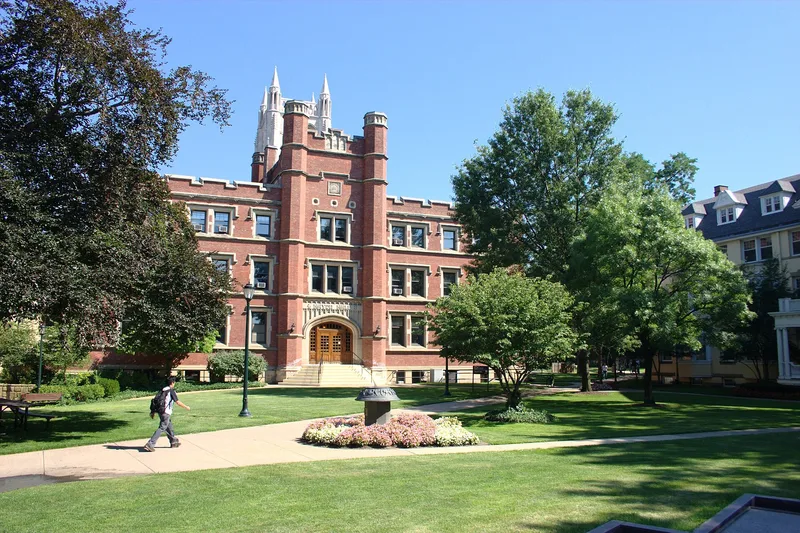
This district on Bellflower Road at Ford Drive in Cleveland contains five buildings put up between 1891 and 1912 for the College for Women of Western Reserve University. Clark Hall, a Queen Anne variant, was designed by Richard M. Hunt and dedicated in 1892 along with Guilford Cottage, by Coburn and Barnum. Charles F. Schweinfurth designed Harkness Memorial Chapel and Haydn Hall in 1901-1902, and later the Flora Stone Mather Memorial of 1910-1912, which received an addition in 1930-1931 by Charles Hopkinson. The buildings face a shared green and have Gothic or late medieval English elements, giving them a visual unity rare on a campus shaped by continuous expansion. The College for Women opened in 1888 after a four-year controversy over coeducation and was the fifth separate women's college in the United States. In 1931 it was renamed for Flora Stone Mather, its chief benefactor. The buildings remain in educational use.
Machine-generated summary. This summary was generated by a language model from the official nomination document and has not been reviewed line by line by an editor. It may contain errors. Check the source document before relying on any detail. Source: nomination document (PDF) · catalog entry. Generated October 2026 (model claude-sonnet-5-5, prompt v1.0-2026-10-29).
| Period of significance | 1891-1912 |
|---|---|
| Styles | Jacobethan, Late Gothic Revival, and Queen Anne variants |
| Areas of significance | Education, Architecture |
| Acreage | 3.6 |
| Boundary source | not published |
| Full listing page | Mather, Flora Stone, College District (property record) |
What listing means for this property
This is a historic district. Buildings within its boundary are either contributing (they add to the district's significance) or non-contributing. Owners of contributing income-producing buildings can claim the 20% federal rehabilitation tax credit; homeowners should look at state credits. National Register districts impose no design review by themselves; a local historic district ordinance, if one exists, does (the difference explained).
General information, not legal or tax advice. Rules change; confirm with your State Historic Preservation Office or a qualified adviser.