Market Square

Why it's listed
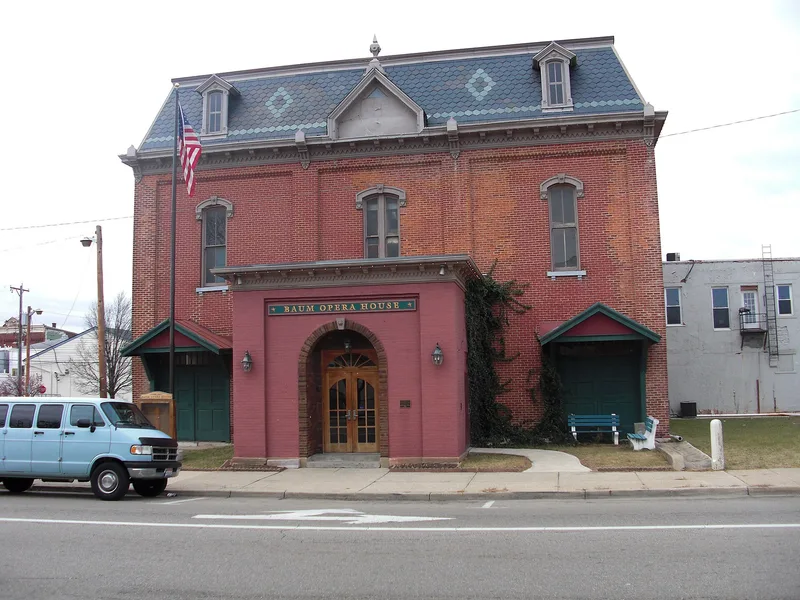
Miamisburg's town center in Montgomery County, Ohio, is a district of roughly 45 to 50 structures gathered around Market Square, where Main Street meets Central Avenue. At its heart is the brick Greek Revival Market Building of 1851, built on land set aside for public use when the town was platted in 1818. It began as an open covered market with meeting rooms above, and its arches were later bricked in for use as a jail and police station. Nearby are the Second Empire Baum Opera House of 1884, the Italianate Groby Bank of 1883, the Gwinner Block, the Liesenhoff Building and the McGuire House. The district was recognized because it preserves a cohesive collection of mid to late nineteenth century vernacular commercial buildings, with a few residences, several of them little altered. Modern intrusions, including a service station and parking lots, are acknowledged within the boundaries.
Machine-generated summary. This summary was generated by a language model from the official nomination document and has not been reviewed line by line by an editor. It may contain errors. Check the source document before relying on any detail. Source: nomination document (PDF) · catalog entry. Generated October 2026 (model claude-sonnet-5-5, prompt v1.0-2026-10-29).
| Styles | Greek Revival (Market Building), Second Empire (Baum Opera House, Gwinner Block), High Victorian Italianate (Groby Bank, Liesenhoff Building, McGuire House), and mixed nineteenth century vernacular commercial |
|---|---|
| Areas of significance | Architecture |
| Acreage | 10.4 |
| Boundary source | NPS cultural-resource GIS polygon |
| Full listing page | Market Square (property record) |
What listing means for this property
This is a historic district. Buildings within its boundary are either contributing (they add to the district's significance) or non-contributing. Owners of contributing income-producing buildings can claim the 20% federal rehabilitation tax credit; homeowners should look at state credits. National Register districts impose no design review by themselves; a local historic district ordinance, if one exists, does (the difference explained).
General information, not legal or tax advice. Rules change; confirm with your State Historic Preservation Office or a qualified adviser.