Kent Industrial District

The National Park Service has not published a boundary polygon for this district; the map shows the listed properties inside it and the district's reference point.
Why it's listed
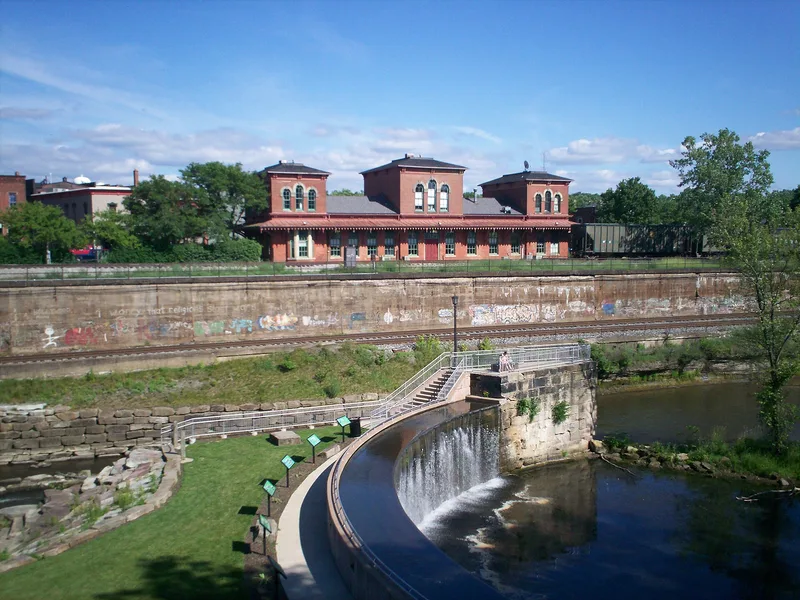
Along both banks of the Cuyahoga River in Kent, Ohio, a small group of structures records the town's industrial and railroad past. The district includes a three-arched sandstone bridge carrying Main Street, a concave stone dam built in the late 1830s, the site of a Pennsylvania and Ohio Canal lock, a five-story brick and stone mill built in 1851, a brick Italian Villa style railroad depot, and a ca. 1910 former livery stable. The dam was erected by the Franklin Silk Company, which failed after the canal diverted river water to Akron. Henry and Marvin Kent built the mill. Marvin Kent also conceived the Atlantic & Great Western Railway, completed in 1864, and the town was renamed in his honor. The depot once held passenger services, offices and a restaurant and now stands vacant. The bridge and dam still serve their original purposes, and the mill has housed several later uses.
Machine-generated summary. This summary was generated by a language model from the official nomination document and has not been reviewed line by line by an editor. It may contain errors. Check the source document before relying on any detail. Source: nomination document (PDF) · catalog entry. Generated October 2026 (model claude-sonnet-5-5, prompt v1.0-2026-10-29).
| Period of significance | 1836-1910 |
|---|---|
| Styles | Italian Villa or Tuscan style (railroad depot) |
| Areas of significance | Industry, Commerce, Transportation, Architecture |
| Acreage | 4.3 |
| Boundary source | not published |
| Full listing page | Kent Industrial District (property record) |
What listing means for this property
This is a historic district. Buildings within its boundary are either contributing (they add to the district's significance) or non-contributing. Owners of contributing income-producing buildings can claim the 20% federal rehabilitation tax credit; homeowners should look at state credits. National Register districts impose no design review by themselves; a local historic district ordinance, if one exists, does (the difference explained).
Noted as vacant in the nomination. Nomination documents can be decades old; current status may differ. If you are considering buying an empty listed property, read the due-diligence checklist.
General information, not legal or tax advice. Rules change; confirm with your State Historic Preservation Office or a qualified adviser.