Hamilton Historic Civic Center

Why it's listed
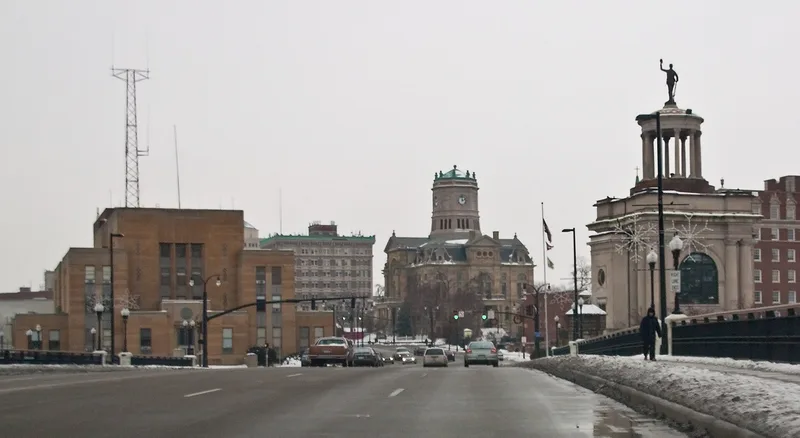
Three blocks of downtown Hamilton, Ohio, on the east bank of the Great Miami River, make up a civic district centered on High Street and the High-Main Street Bridge. The 1934 Municipal Building is a high-style Art Deco design with reinforced concrete walls, stone veneer and carved panels showing local industry and early transportation. Beside it stands the Art Moderne Nash Building, built around 1931 as a bus station. Across the street is the seven-story Anthony Wayne Hotel of 1927, a Second Renaissance Revival building with rusticated stone and terra cotta trim. Monument Place is a park holding the 1902-1903 Soldier's, Sailor's and Pioneer's Monument, topped by a bronze Union soldier, along with a 1901 stockade-style retaining wall and many plaques. The 1914 bridge carries five reinforced concrete arches across about 503 feet of river. Together these resources record Hamilton's civic life, early settlement at Fort Hamilton and twentieth-century architecture. The Rialto Theatre and a relocated log cabin are counted as non-contributing.
Machine-generated summary. This summary was generated by a language model from the official nomination document and has not been reviewed line by line by an editor. It may contain errors. Check the source document before relying on any detail. Source: nomination document (PDF) · catalog entry. Generated October 2026 (model claude-sonnet-5-5, prompt v1.0-2026-10-29).
| Styles | Late 19th & 20th Century Revival - Classical Revival; Modern Movement - Art Deco, Art Moderne |
|---|---|
| Areas of significance | Community Planning and Development, Architecture |
| Acreage | 4 |
| Boundary source | NPS cultural-resource GIS polygon |
| Full listing page | Hamilton Historic Civic Center (property record) |
What listing means for this property
This is a historic district. Buildings within its boundary are either contributing (they add to the district's significance) or non-contributing. Owners of contributing income-producing buildings can claim the 20% federal rehabilitation tax credit; homeowners should look at state credits. National Register districts impose no design review by themselves; a local historic district ordinance, if one exists, does (the difference explained).
General information, not legal or tax advice. Rules change; confirm with your State Historic Preservation Office or a qualified adviser.