East Second Street District

The National Park Service has not published a boundary polygon for this district; the map shows the listed properties inside it and the district's reference point.
Why it's listed
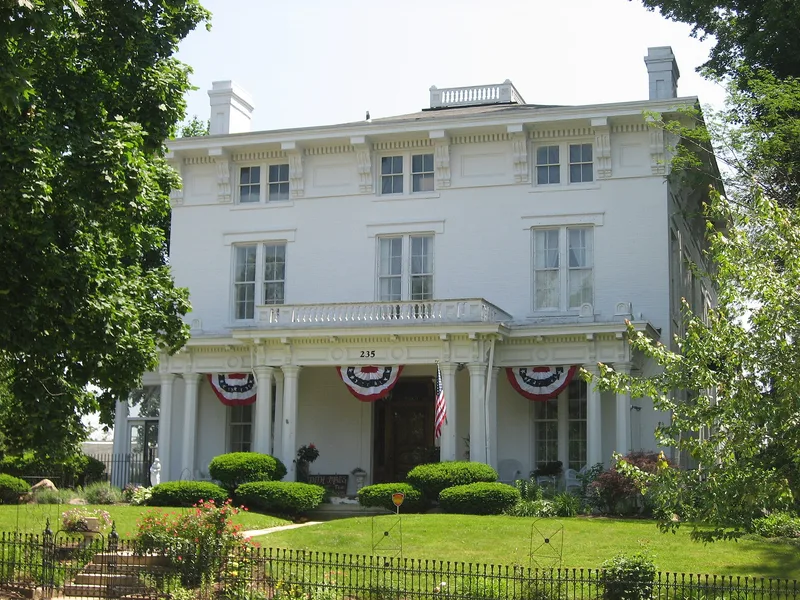
Two adjoining 19th-century houses on East Second Street in Xenia, Ohio, make up this small district. The Hivling-Kinney House, built in 1863 by Abraham Hivling, is a 2½-story brick late Classic Revival residence with tapering eight-sided porch columns, iron balconies, cranberry-glass door glazing and a hip roof with a bracketed cornice. Its circular staircase and cupola were lost in a 1912 fire. Next door, the John Allen House, dated 1881 on a chimney, is a red brick Victorian building with carved stone, decorative brickwork and an unusually varied set of fireplaces. Both sit on large lots that have escaped later subdivision. They were built 18 years apart by related men prominent in early Xenia. Coates Kinney, a poet, journalist and Ohio state senator, lived in the Hivling house after marrying into the family. Both houses stayed in the family until 1972, and the Allen House had been divided into apartments.
Machine-generated summary. This summary was generated by a language model from the official nomination document and has not been reviewed line by line by an editor. It may contain errors. Check the source document before relying on any detail. Source: nomination document (PDF) · catalog entry. Generated October 2026 (model claude-sonnet-5-5, prompt v1.0-2026-10-29).
| Period of significance | 19th Century (specific dates: Hivling-Kinney House 1863, Allen House 1881) |
|---|---|
| Styles | Late Classic Revival (Hivling-Kinney House); Victorian, described as Tudor (Allen House) |
| Areas of significance | Literature, Architecture |
| Acreage | 2.1 |
| Boundary source | not published |
| Full listing page | East Second Street District (property record) |
What listing means for this property
This is a historic district. Buildings within its boundary are either contributing (they add to the district's significance) or non-contributing. Owners of contributing income-producing buildings can claim the 20% federal rehabilitation tax credit; homeowners should look at state credits. National Register districts impose no design review by themselves; a local historic district ordinance, if one exists, does (the difference explained).
General information, not legal or tax advice. Rules change; confirm with your State Historic Preservation Office or a qualified adviser.