East 89th Street Historic District

Why it's listed
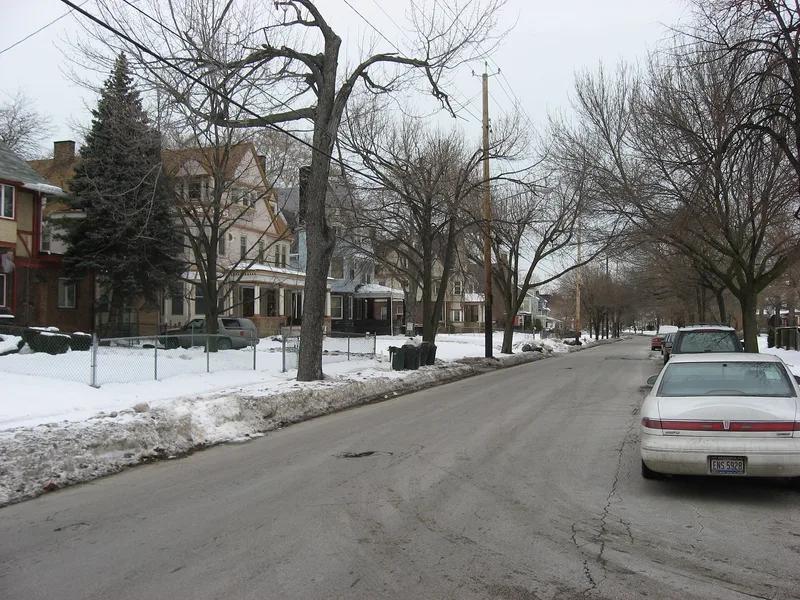
East 89th Street, running between Chester and Hough Avenues on Cleveland's east side, holds thirty-two buildings, mostly large frame houses of two and a half stories set back about fifteen feet on generous lots. The earliest, an Italianate house of about 1875, was the first built on the street, and construction continued into 1912. Its proximity to Euclid Avenue made it a desirable address, and several business leaders lived here, including the president of the National Refining Company and a Chamber of Commerce president. The street displays Queen Anne turrets and wraparound porches, Colonial Revival and Dutch Colonial Revival designs, a Richardsonian Romanesque brick house, and two apartment buildings, one Neoclassical and one with Tudor Revival elements. Architects included Coburn and Barnum and Rogers, MacFarlane of Detroit. Later decades brought boarding houses and population decline in the Hough area, yet this street remains the most intact of the neighborhood's once-wealthy streets, which is the basis for its listing for architecture.
Machine-generated summary. This summary was generated by a language model from the official nomination document and has not been reviewed line by line by an editor. It may contain errors. Check the source document before relying on any detail. Source: nomination document (PDF) · catalog entry. Generated October 2026 (model claude-sonnet-5-5, prompt v1.0-2026-10-29).
| Period of significance | 1870s-1912 |
|---|---|
| Styles | Italianate, Queen Anne, Colonial Revival |
| Areas of significance | Architecture |
| Acreage | 8 |
| Boundary source | NPS cultural-resource GIS polygon |
| Full listing page | East 89th Street Historic District (property record) |
What listing means for this property
This is a historic district. Buildings within its boundary are either contributing (they add to the district's significance) or non-contributing. Owners of contributing income-producing buildings can claim the 20% federal rehabilitation tax credit; homeowners should look at state credits. National Register districts impose no design review by themselves; a local historic district ordinance, if one exists, does (the difference explained).
General information, not legal or tax advice. Rules change; confirm with your State Historic Preservation Office or a qualified adviser.