Dayton-Campbell Historic District

Why it's listed
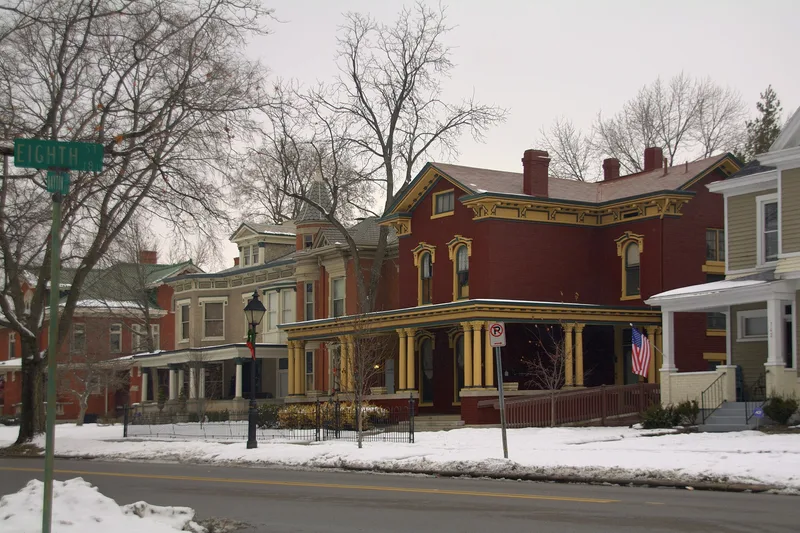
Northeast Hamilton holds a neighborhood of roughly 210 buildings, mostly houses, laid out along Dayton Street, High Street and Campbell Avenue. Development began in the 1870s on land held by paper manufacturer William Beckett and Congressman Lewis D. Campbell, who donated the strip that became Campbell Avenue's tree-lined boulevard. Hamilton's rapid industrial growth, driven by machinery and paper companies, drew founders and managers of firms such as Niles Tool Works, Sohn & Rentschler and Black-Clawson to build large homes here in the 1880s and 1890s. The streets show Italianate, Gothic Revival, Queen Anne, Colonial Revival, Neo-Classical and Prairie designs, with Queen Anne the most common. Churches, synagogues, a hosiery mill, carriage works and early automobile showrooms add variety. Smaller houses fill the numbered side streets, while High Street retains institutional buildings by the local firm Mueller & Hair. The district is recognized for this cohesive mix of grand and modest architecture tied to the city's industrial prosperity.
Machine-generated summary. This summary was generated by a language model from the official nomination document and has not been reviewed line by line by an editor. It may contain errors. Check the source document before relying on any detail. Source: nomination document (PDF) · catalog entry. Generated October 2026 (model claude-sonnet-5-5, prompt v1.0-2026-10-29).
| Period of significance | 1870s - 1920s |
|---|---|
| Styles | Queen Anne (predominant), Italianate, Gothic Revival, Colonial Revival, Neo-Classical, Prairie |
| Areas of significance | Industry, Architecture |
| Acreage | 24 |
| Boundary source | NPS cultural-resource GIS polygon |
| Full listing page | Dayton-Campbell Historic District (property record) |
What listing means for this property
This is a historic district. Buildings within its boundary are either contributing (they add to the district's significance) or non-contributing. Owners of contributing income-producing buildings can claim the 20% federal rehabilitation tax credit; homeowners should look at state credits. National Register districts impose no design review by themselves; a local historic district ordinance, if one exists, does (the difference explained).
General information, not legal or tax advice. Rules change; confirm with your State Historic Preservation Office or a qualified adviser.