Cleveland Public Square

The National Park Service has not published a boundary polygon for this district; the map shows the listed properties inside it and the district's reference point.
Why it's listed
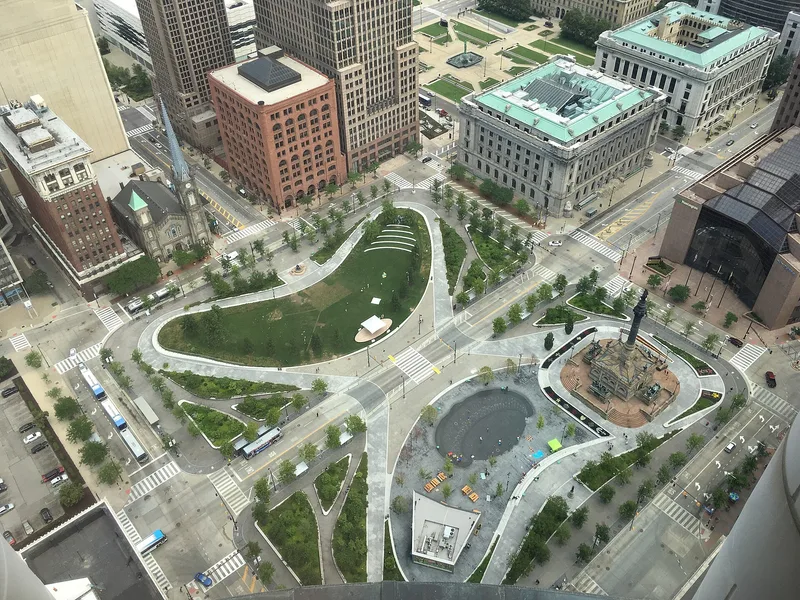
Public Square is the central park of downtown Cleveland, laid out in 1796 as part of the town plan on one of the original ten-acre lots. Superior Avenue and Ontario Street cross it, dividing it into four quadrants that now total just under five acres after street widening. The northwest quadrant holds an 1915 statue of Mayor Tom L. Johnson by Herman N. Matzen, and the southwest holds an 1888 bronze of city founder Moses Cleaveland by J. C. Hamilton. The southeast quadrant contains the Soldiers' and Sailors' Monument, completed in 1894 and designed by architect-sculptor Levi T. Scofield. It has a 125-foot granite shaft topped by a statue of Liberty, bronze groups representing four military branches, and a memorial room naming 6,000 Cuyahoga County veterans. The square was listed as a rare survival of eighteenth-century town planning and for its sculpture, which shows the Victorian habit of using realistic detail to express abstract ideals.
Machine-generated summary. This summary was generated by a language model from the official nomination document and has not been reviewed line by line by an editor. It may contain errors. Check the source document before relying on any detail. Source: nomination document (PDF) · catalog entry. Generated October 2026 (model claude-sonnet-5-5, prompt v1.0-2026-10-29).
| Styles | Soldiers' and Sailors' Monument described as not in any historic style, with ornament derived from military symbols |
|---|---|
| Areas of significance | Community Planning and Development, Art, Architecture |
| Acreage | 5 |
| Boundary source | not published |
| Full listing page | Cleveland Public Square (property record) |
What listing means for this property
This is a historic district. Buildings within its boundary are either contributing (they add to the district's significance) or non-contributing. Owners of contributing income-producing buildings can claim the 20% federal rehabilitation tax credit; homeowners should look at state credits. National Register districts impose no design review by themselves; a local historic district ordinance, if one exists, does (the difference explained).
General information, not legal or tax advice. Rules change; confirm with your State Historic Preservation Office or a qualified adviser.