Wright Brothers National Memorial

Why it's listed
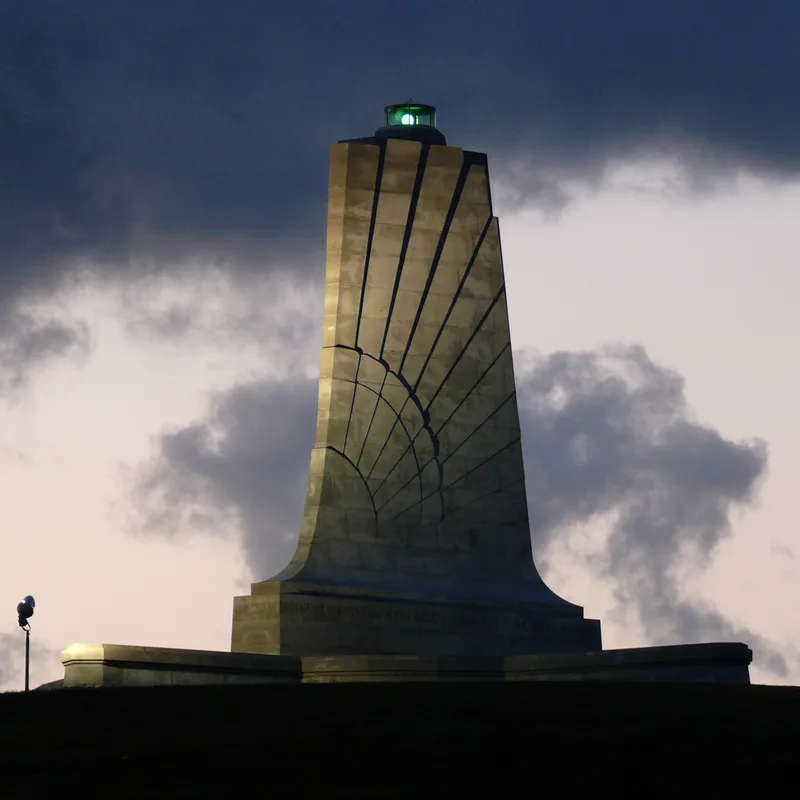
Kill Devil Hills in Dare County, North Carolina, is where Orville and Wilbur Wright carried out their glider experiments and, on December 17, 1903, made the first powered flight. The Wrights chose the area for its open sand and steady winds and made more than a thousand glider flights from Kill Devil Hill between 1900 and 1902. A 60-foot triangular gray granite shaft, designed by Rogers & Poor and completed in 1932, crowns the hill, with wing reliefs on its sides. Nearby, replicas of the 1903 hangar and living quarters were built in 1953 and later rebuilt, using untreated pine as the originals were. Markers show the takeoff and landing spots. A visitor center and 3,000-foot airstrip, both finished in 1963, are counted as consistent with the memorial's purpose. Postwar development has covered much of the open beach, though the first flight area is kept in short grass. The superintendent's house and maintenance area are listed as non-contributing.
Machine-generated summary. This summary was generated by a language model from the official nomination document and has not been reviewed line by line by an editor. It may contain errors. Check the source document before relying on any detail. Source: nomination document (PDF) · catalog entry. Generated October 2026 (model claude-sonnet-5-5, prompt v1.0-2026-10-29).
| Period of significance | 1900- |
|---|---|
| Areas of significance | Invention, Architecture, Landscape Architecture, Conservation, Transportation |
| Acreage | 431 |
| Boundary source | NPS cultural-resource GIS polygon |
| Full listing page | Wright Brothers National Memorial (property record) |
What listing means for this property
This is a historic district. Buildings within its boundary are either contributing (they add to the district's significance) or non-contributing. Owners of contributing income-producing buildings can claim the 20% federal rehabilitation tax credit; homeowners should look at state credits. National Register districts impose no design review by themselves; a local historic district ordinance, if one exists, does (the difference explained).
General information, not legal or tax advice. Rules change; confirm with your State Historic Preservation Office or a qualified adviser.