White Street-Valdese Avenue Historic District

Why it's listed
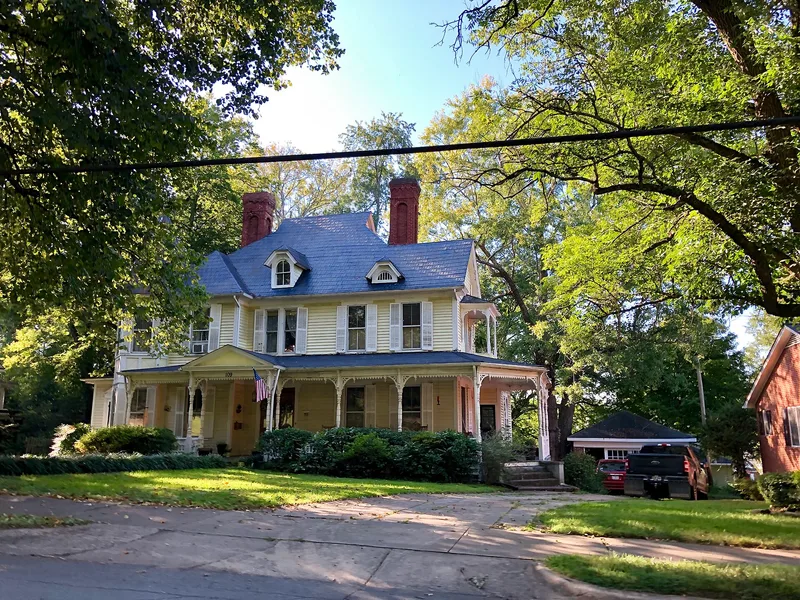
Northeast of downtown Morganton, this district of about 22 acres follows parts of White Street and Valdese Avenue. It holds 45 buildings erected between about 1885 and 1936, mostly houses ranging from substantial Victorian and Queen Anne homes to small cottages and bungalows. Much of Valdese Avenue was once part of the Claywell family's Broadoaks farm, and the earliest surviving house, built about 1885 by Edward B. Claywell, still stands. Larger houses came first, followed by more modest infill, a pattern repeated in other Morganton neighborhoods. The district also includes the 1905 Colonial Revival main building of Broadoaks Sanitarium, a private hospital for nervous disorders founded in 1902 by men associated with Broughton Hospital. It closed in 1959 and has since been rehabilitated as offices. Two houses on White Street are associated with the Avery and Hennessee families, who were Black. Thirty-eight of the 45 buildings contribute to the district's character, and its architecture and development history supported its listing.
Machine-generated summary. This summary was generated by a language model from the official nomination document and has not been reviewed line by line by an editor. It may contain errors. Check the source document before relying on any detail. Source: nomination document (PDF) · catalog entry. Generated October 2026 (model claude-sonnet-5-5, prompt v1.0-2026-10-29).
| Period of significance | ca. 1885-ca. 1936 |
|---|---|
| Styles | Victorian, Queen Anne, Colonial Revival, bungalow and cottage residences |
| Areas of significance | Community Planning and Development, Architecture, Social History |
| Acreage | 22 |
| Boundary source | NPS cultural-resource GIS polygon |
| Full listing page | White Street-Valdese Avenue Historic District (property record) |
What listing means for this property
This is a historic district. Buildings within its boundary are either contributing (they add to the district's significance) or non-contributing. Owners of contributing income-producing buildings can claim the 20% federal rehabilitation tax credit; homeowners should look at state credits. National Register districts impose no design review by themselves; a local historic district ordinance, if one exists, does (the difference explained).
General information, not legal or tax advice. Rules change; confirm with your State Historic Preservation Office or a qualified adviser.