West Main Street Historic District

Why it's listed
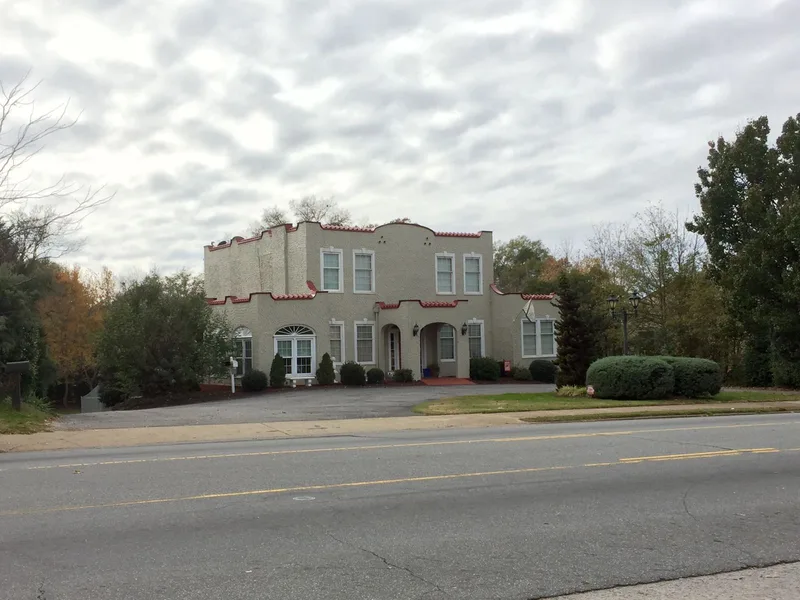
West Main Street Historic District is a roughly twenty-seven-acre stretch of Forest City, North Carolina, beginning two blocks west of downtown. It contains twenty-two primary resources, including the 1867 Cool Springs Cemetery, fifteen early to mid-twentieth-century houses, the 1924-1925 Cool Springs High School, the 1940 First Presbyterian Church, the 1958 Cool Springs Gymnasium, a 1964 service station and a 1965 medical office. The houses range from modest bungalows to two-story Neoclassical, Colonial, Dutch Colonial, Spanish Colonial and Mediterranean Revival dwellings. Most contributing buildings date from the 1920s and 1930s, a period of population growth after railroads and textile mills arrived. Subdivision of land along West Main Street and the building of the high school in 1924 encouraged new housing. The district was recognized as locally significant for its largely intact collection of residential, religious, funerary, educational and recreational buildings spanning 1867 to 1958, with about ninety percent of resources contributing.
Machine-generated summary. This summary was generated by a language model from the official nomination document and has not been reviewed line by line by an editor. It may contain errors. Check the source document before relying on any detail. Source: nomination document (PDF) · catalog entry. Generated October 2026 (model claude-sonnet-5-5, prompt v1.0-2026-10-29).
| Period of significance | 1867-1958 |
|---|---|
| Styles | Bungalow/Craftsman, Colonial Revival, Classical Revival, Spanish Colonial Revival, Modern Movement, Mediterranean Revival, Ranch, Dutch Colonial Revival |
| Areas of significance | Architecture, Art |
| Acreage | 27 |
| Boundary source | NPS cultural-resource GIS polygon |
| Full listing page | West Main Street Historic District (property record) |
What listing means for this property
This is a historic district. Buildings within its boundary are either contributing (they add to the district's significance) or non-contributing. Owners of contributing income-producing buildings can claim the 20% federal rehabilitation tax credit; homeowners should look at state credits. National Register districts impose no design review by themselves; a local historic district ordinance, if one exists, does (the difference explained).
General information, not legal or tax advice. Rules change; confirm with your State Historic Preservation Office or a qualified adviser.