Tabernacle Methodist Protestant Church and Cemetery

The National Park Service has not published a boundary polygon for this district; the map shows the listed properties inside it and the district's reference point.
Why it's listed
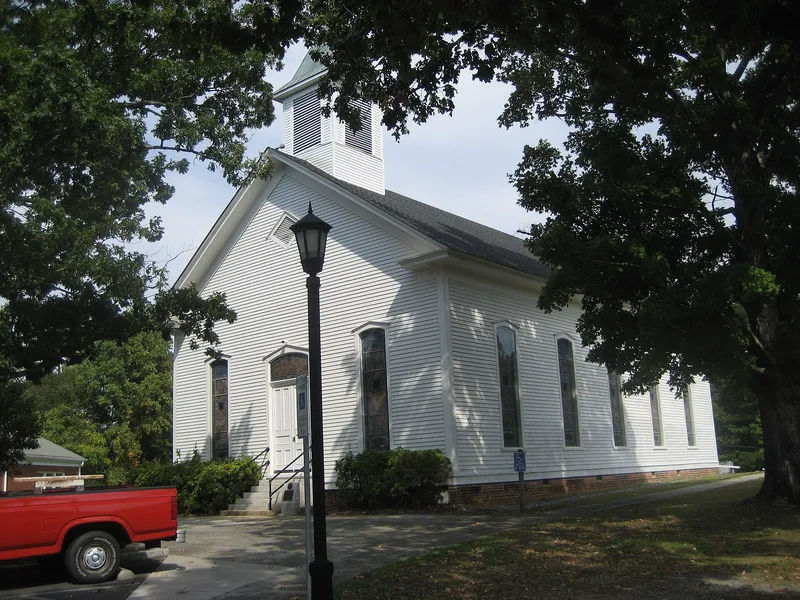
Tabernacle Methodist Protestant Church and Cemetery occupies a knoll along Liberty Road, roughly ten miles south of Greensboro. The weatherboarded frame sanctuary, finished in June 1891 for $2,500, is a simple Gothic Revival design with a five-bay plan, stained glass windows and an interior of original heart-pine ceiling, wainscot, pews and pulpit. Behind and beside it lies a cemetery whose oldest marked stone dates from 1822, with granite obelisks, urns, lamb figures and tablet markers from the nineteenth and early twentieth centuries. The site began as an eighteenth-century campground called Eden, visited by Methodist circuit riders, and later hosted several annual conferences of the Methodist Protestant Church. It was listed for its role in Methodism in Guilford County, for the church as a well-preserved rural frame church, and for the variety of funerary art in the graveyard. Newer brick buildings stand nearby, but the 1891 church is the only nineteenth-century building left.
Machine-generated summary. This summary was generated by a language model from the official nomination document and has not been reviewed line by line by an editor. It may contain errors. Check the source document before relying on any detail. Source: nomination document (PDF) · catalog entry. Generated October 2026 (model claude-sonnet-5-5, prompt v1.0-2026-10-29).
| Period of significance | 1822-1945 |
|---|---|
| Styles | Gothic Revival |
| Areas of significance | Religion, Architecture, Art |
| Acreage | 6 |
| Boundary source | not published |
| Full listing page | Tabernacle Methodist Protestant Church and Cemetery (property record) |
What listing means for this property
This is a historic district. Buildings within its boundary are either contributing (they add to the district's significance) or non-contributing. Owners of contributing income-producing buildings can claim the 20% federal rehabilitation tax credit; homeowners should look at state credits. National Register districts impose no design review by themselves; a local historic district ordinance, if one exists, does (the difference explained).
General information, not legal or tax advice. Rules change; confirm with your State Historic Preservation Office or a qualified adviser.