Spray Industrial Historic District

Why it's listed
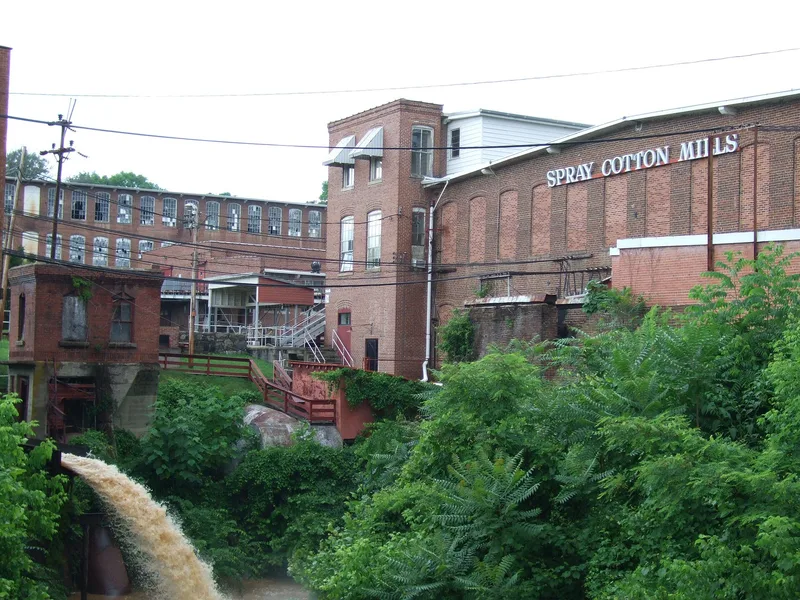
Along the west bank of the Smith River in Eden, the Spray Industrial Historic District covers about 150 acres of brick textile mills, workers' houses, commercial buildings and water-power works. Its origins lie in the 1810s, when James Barnett built a dam, a 4,200-foot canal and a grist mill. John Motley Morehead later used the canal to power Eden's first textile factory, and his descendants added more mills. Most of the eight mills date from 1893 to 1903, and they share thick brick walls, heavy timber interiors, segmental-arched windows and tall stair towers. Around them stand frame mill houses along Riverside Drive, four larger bungalows built for mill administrators, and commercial buildings such as the 1890 Spray Mercantile Building and the 1912 Imperial Trust and Savings Bank. The district has seen little change since the 1930s, apart from bricked-in windows, shortened towers and two modern infill structures. It was listed as a well-preserved example of a North Carolina textile center.
Machine-generated summary. This summary was generated by a language model from the official nomination document and has not been reviewed line by line by an editor. It may contain errors. Check the source document before relying on any detail. Source: nomination document (PDF) · catalog entry. Generated October 2026 (model claude-sonnet-5-5, prompt v1.0-2026-10-29).
| Styles | Standard mill construction; Neoclassical Revival (Imperial Trust and Savings Bank); bungalow and mill house types |
|---|---|
| Areas of significance | Industry, Commerce, Exploration/Settlement, Architecture, Invention |
| Acreage | 151 |
| Boundary source | NPS cultural-resource GIS polygon |
| Full listing page | Spray Industrial Historic District (property record) |
What listing means for this property
This is a historic district. Buildings within its boundary are either contributing (they add to the district's significance) or non-contributing. Owners of contributing income-producing buildings can claim the 20% federal rehabilitation tax credit; homeowners should look at state credits. National Register districts impose no design review by themselves; a local historic district ordinance, if one exists, does (the difference explained).
General information, not legal or tax advice. Rules change; confirm with your State Historic Preservation Office or a qualified adviser.