Shaw Family Farms

Why it's listed
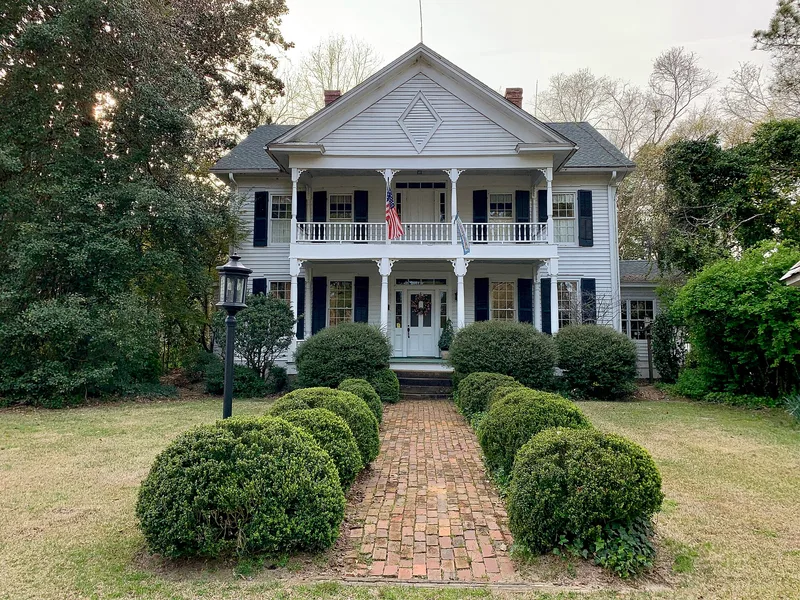
Three farmhouses stand close together along SR 1405 southeast of Wagram, surrounded by about 575 acres of fields, pastures and woodland. Dr. Daniel Shaw built the largest house about 1885, a two-story frame dwelling with a two-tier pedimented porch. His son Alexander Edwin Shaw built a rambling one-story house with a wraparound porch of turned posts at about the same time. Another son, Dr. William Graham Shaw, built a Queen Anne-influenced one-story house around 1900. Outbuildings include an octagonal lattice gazebo, two lattice-covered washhouses, a pumphouse and a commissary. The Shaws were prominent in farming, medicine, education, banking and politics in Scotland County, and the houses served as family residences into the 1930s. Together they show three popular local house forms built with money from a strong cotton economy, and they make up what the nomination calls the finest group of neighboring family farms in the county.
Machine-generated summary. This summary was generated by a language model from the official nomination document and has not been reviewed line by line by an editor. It may contain errors. Check the source document before relying on any detail. Source: nomination document (PDF) · catalog entry. Generated October 2026 (model claude-sonnet-5-5, prompt v1.0-2026-10-29).
| Period of significance | 1800-1899 (ca. 1885 and turn of century) |
|---|---|
| Styles | Late Greek Revival trim (Dr. Daniel Shaw House); rambling vernacular frame with Victorian porch (A. E. Shaw House); simplified Queen Anne with Colonial Revival interior (Dr. W. G. Shaw House) |
| Areas of significance | Health/Medicine, Architecture, Agriculture |
| Acreage | 584.3 |
| Boundary source | NPS cultural-resource GIS polygon |
| Full listing page | Shaw Family Farms (property record) |
What listing means for this property
This is a historic district. Buildings within its boundary are either contributing (they add to the district's significance) or non-contributing. Owners of contributing income-producing buildings can claim the 20% federal rehabilitation tax credit; homeowners should look at state credits. National Register districts impose no design review by themselves; a local historic district ordinance, if one exists, does (the difference explained).
General information, not legal or tax advice. Rules change; confirm with your State Historic Preservation Office or a qualified adviser.