Shaver Rental Houses District

The National Park Service has not published a boundary polygon for this district; the map shows the listed properties inside it and the district's reference point.
Why it's listed
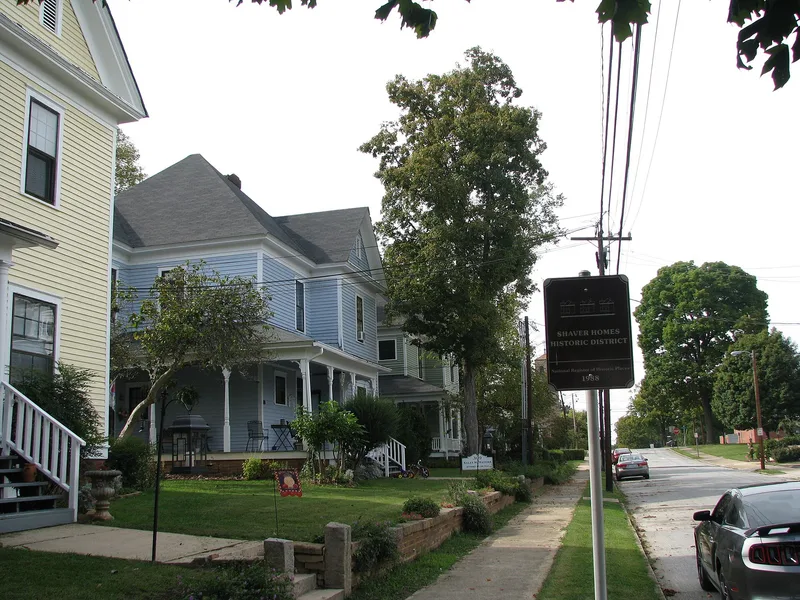
Four Queen Anne style frame houses stand together at the southwest corner of West Council and North Jackson Streets in Salisbury. Three two-story houses at 303, 309 and 315 West Council were built about 1907 by landlord Edwin Shaver; one served as a boarding house and another as a Lutheran parsonage. The one-story cottage at 120 North Jackson was built about 1899 by Dr. John Whitehead and was moved from across the street in 1986 to avoid demolition for church parking. The houses retain original interiors, including beaded pine wainscoting, classical mantels and early plumbing fixtures. They were listed as examples of rental housing built when Salisbury's population doubled between 1900 and 1910, after the Southern Railroad opened its repair shops nearby. The group is also notable as the only turn-of-the-century buildings left in their block, and it illustrates modest Queen Anne design popular until about 1910.
Machine-generated summary. This summary was generated by a language model from the official nomination document and has not been reviewed line by line by an editor. It may contain errors. Check the source document before relying on any detail. Source: nomination document (PDF) · catalog entry. Generated October 2026 (model claude-sonnet-5-5, prompt v1.0-2026-10-29).
| Period of significance | ca 1899-1910 |
|---|---|
| Styles | Queen Anne |
| Areas of significance | Architecture |
| Acreage | 0.7 |
| Boundary source | not published |
| Full listing page | Shaver Rental Houses District (property record) |
What listing means for this property
This is a historic district. Buildings within its boundary are either contributing (they add to the district's significance) or non-contributing. Owners of contributing income-producing buildings can claim the 20% federal rehabilitation tax credit; homeowners should look at state credits. National Register districts impose no design review by themselves; a local historic district ordinance, if one exists, does (the difference explained).
Noted as vacant in the nomination. Nomination documents can be decades old; current status may differ. If you are considering buying an empty listed property, read the due-diligence checklist.
General information, not legal or tax advice. Rules change; confirm with your State Historic Preservation Office or a qualified adviser.