Pleasant Grove Camp Meeting Ground

The National Park Service has not published a boundary polygon for this district; the map shows the listed properties inside it and the district's reference point.
Why it's listed
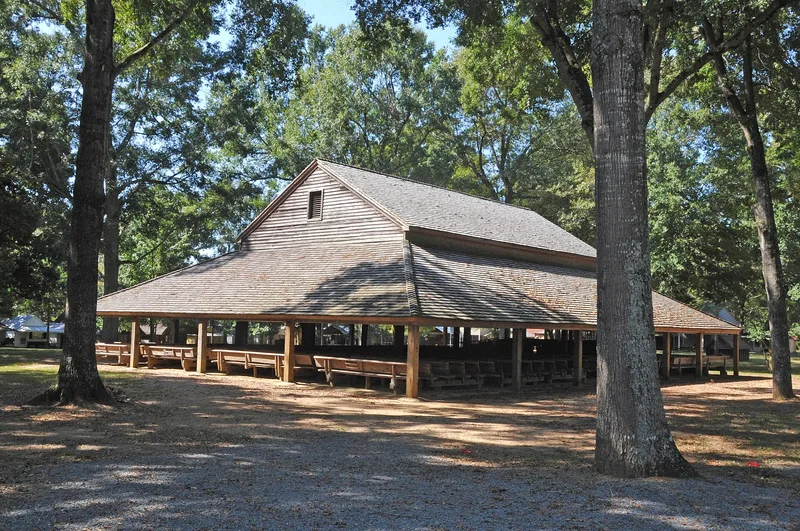
Pleasant Grove Camp Meeting Ground is a rural religious gathering site near Waxhaw in Union County, North Carolina. Trustees of the Methodist Episcopal Church bought twenty-four acres in 1830, and the site grew from the earlier McWhirter Camp Ground, which lacked a good water supply. A five-acre open square is lined with small frame "tents" once occupied by families during the annual meeting. At its center stands an open-sided frame arbor, eighty by sixty feet, with mortise-and-tenon framing said to date from 1830 and a hip-style pent roof. A frame church dating from 1895 and a former schoolhouse used as a preacher's dwelling stand nearby, along with a graveyard. More than 200 tents were reportedly built before 1860, but the grounds were closed in 1902 and all but one tent were torn down. Renewed interest brought seventy-one rebuilt tents by 1935. The site is described as a rare, still-functioning survivor of the nineteenth-century Great Revival.
Machine-generated summary. This summary was generated by a language model from the official nomination document and has not been reviewed line by line by an editor. It may contain errors. Check the source document before relying on any detail. Source: nomination document (PDF) · catalog entry. Generated October 2026 (model claude-sonnet-5-5, prompt v1.0-2026-10-29).
| Styles | Vernacular architecture |
|---|---|
| Areas of significance | Architecture, Religion |
| Acreage | 9.9 |
| Boundary source | not published |
| Full listing page | Pleasant Grove Camp Meeting Ground (property record) |
What listing means for this property
This is a historic district. Buildings within its boundary are either contributing (they add to the district's significance) or non-contributing. Owners of contributing income-producing buildings can claim the 20% federal rehabilitation tax credit; homeowners should look at state credits. National Register districts impose no design review by themselves; a local historic district ordinance, if one exists, does (the difference explained).
General information, not legal or tax advice. Rules change; confirm with your State Historic Preservation Office or a qualified adviser.