Mount Airy Historic District (Boundary Increase II)

The National Park Service has not published a boundary polygon for this district; the map shows the listed properties inside it and the district's reference point.
Why it's listed
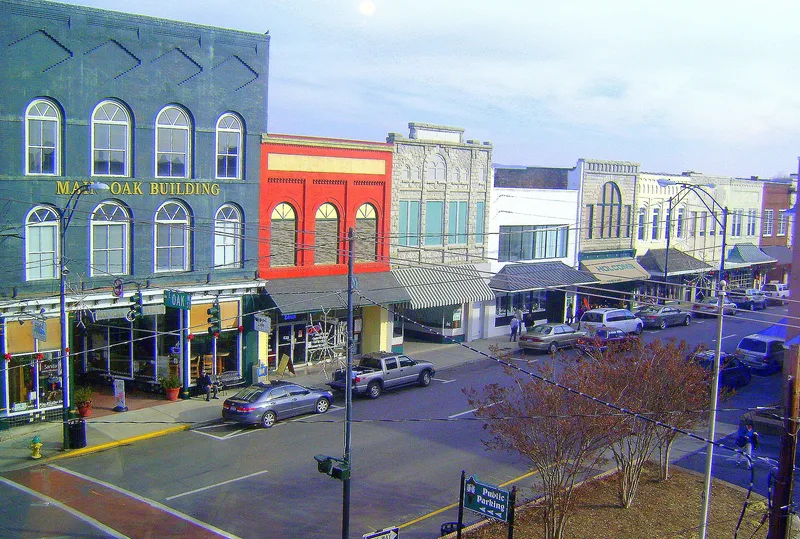
Mount Airy's central business district and four adjoining residential neighborhoods form this district of 248 buildings, most dating from 1880 to 1930. Its most distinctive material is a pale granite quarried just east of town, used for commercial, institutional and residential buildings alike. Styles include Italianate, Queen Anne, Gothic Revival, Romanesque Revival and Art Deco, among others. The district grew from a stagecoach stop on the road between the North Carolina piedmont and southern Virginia. Tobacco manufacturing expanded in the 1870s and 1880s, and the arrival of the Cape Fear and Yadkin Valley Railroad in 1888 spurred rapid growth, with the population rising from about 500 in 1880 to about 3,000 by 1893. A second building wave occurred in the 1920s and 1930s, when textiles revived. Four granite churches, a former tobacco warehouse, and residences with granite retaining walls and intact siding illustrate this history.
Machine-generated summary. This summary was generated by a language model from the official nomination document and has not been reviewed line by line by an editor. It may contain errors. Check the source document before relying on any detail. Source: nomination document (PDF) · catalog entry. Generated October 2026 (model claude-haiku-5-5, prompt v1.1-2026-10-29).
| Period of significance | 1880-1935 |
|---|---|
| Styles | Italianate, Queen Anne, Gothic Revival, Romanesque Revival, Art Deco, Spanish Colonial Revival, English Cottage, Tudor Revival |
| Areas of significance | Industry, Architecture |
| Acreage | 65 |
| Boundary source | not published |
| Full listing page | Mount Airy Historic District (Boundary Increase II) (property record) |
What listing means for this property
This is a historic district. Buildings within its boundary are either contributing (they add to the district's significance) or non-contributing. Owners of contributing income-producing buildings can claim the 20% federal rehabilitation tax credit; homeowners should look at state credits. National Register districts impose no design review by themselves; a local historic district ordinance, if one exists, does (the difference explained).
General information, not legal or tax advice. Rules change; confirm with your State Historic Preservation Office or a qualified adviser.