Market House Square District

The National Park Service has not published a boundary polygon for this district; the map shows the listed properties inside it and the district's reference point.
Why it's listed
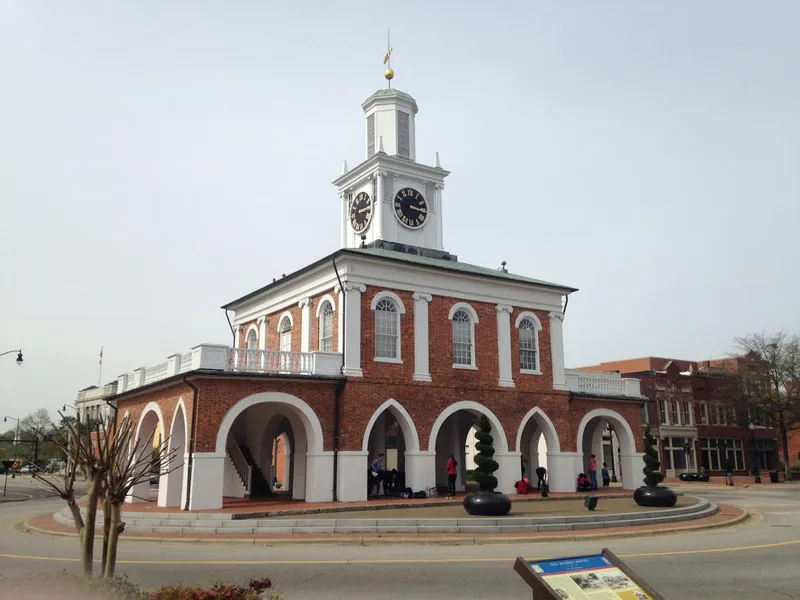
Eleven structures surround Market House Square in downtown Fayetteville, the focal point being the brick Market House of the 1830s, modeled on an eighteenth century English town hall with an open arcade, a cupola and a low dome. The remaining ten buildings were erected between about 1884 and 1926 and show a range of styles across a single commercial block. Twin Italianate storefronts at 106 and 108 Person Street have metal window heads and a shared bracketed cornice. The Sedberry-MacKethan Drugstore, a three-story building with a bell-cast mansard roof, is in the Second Empire style. The Knights of Pythias hall of about 1893 is in the Norman Revival style, and the Stein-Lawyer's Building of about 1916 has Mediterranean Revival features. The ten-story First Citizen's Bank Building, opened in 1926, is Neo-Classical and was the tallest building in the city for many years. The group records how Fayetteville's commercial center grew and changed.
Machine-generated summary. This summary was generated by a language model from the official nomination document and has not been reviewed line by line by an editor. It may contain errors. Check the source document before relying on any detail. Source: nomination document (PDF) · catalog entry. Generated October 2026 (model claude-haiku-5-5, prompt v1.1-2026-10-29).
| Styles | Italianate, Second Empire, Late Victorian revival, Norman Revival, Mediterranean Revival, Neo-Classical Revival |
|---|---|
| Areas of significance | Commerce, Architecture |
| Acreage | 4.9 |
| Boundary source | not published |
| Full listing page | Market House Square District (property record) |
What listing means for this property
This is a historic district. Buildings within its boundary are either contributing (they add to the district's significance) or non-contributing. Owners of contributing income-producing buildings can claim the 20% federal rehabilitation tax credit; homeowners should look at state credits. National Register districts impose no design review by themselves; a local historic district ordinance, if one exists, does (the difference explained).
General information, not legal or tax advice. Rules change; confirm with your State Historic Preservation Office or a qualified adviser.