Lenoir Downtown Historic District (Boundary Increase)

The National Park Service has not published a boundary polygon for this district; the map shows the listed properties inside it and the district's reference point.
Why it's listed
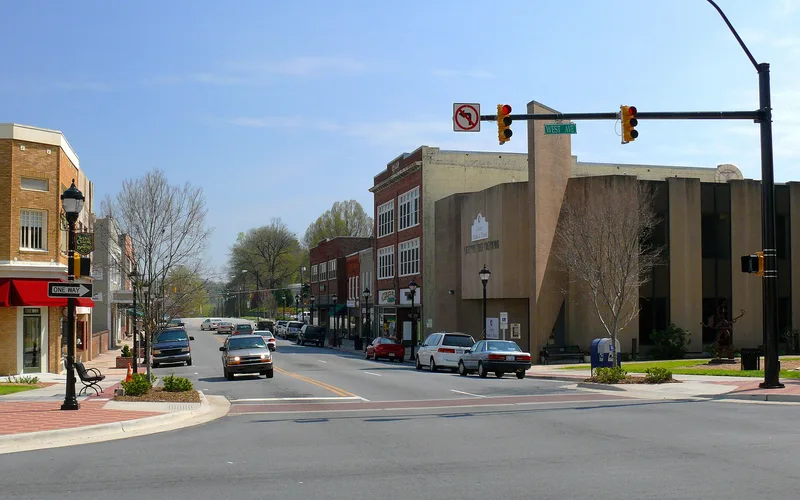
Downtown Lenoir, the Caldwell County seat since 1841, is represented by a historic district of brick commercial and government buildings arranged around the square where Main Street meets West Avenue. The district covers three full blocks and parts of five more, with about fifty buildings, two structures and seven objects, roughly two-thirds of them contributing. Most buildings are one or two stories, with a few three-story landmarks at key corners. The earliest intact commercial building is an Italianate warehouse on Church Street from about 1888. The Courtney buildings on West Avenue, dating from 1897 and 1908, show elaborate Italianate and Classical Revival facades, while the 1907 Lenoir Building is Romanesque Revival. Late-1920s landmarks include the 1929 courthouse, the 1930 post office and the First National Bank Building. Department stores from the 1920s and 1940s reflect Commercial Style and modern influences. Plazas around the square hold a Confederate monument, a war memorial, a bandstand and a bench from the 1929 courthouse remodeling.
Machine-generated summary. This summary was generated by a language model from the official nomination document and has not been reviewed line by line by an editor. It may contain errors. Check the source document before relying on any detail. Source: nomination document (PDF). Generated October 2026 (model claude-sonnet-5-5, prompt v1.0-2026-10-29).
| Styles | Commercial Style, Classical Revival, Tudor Revival, Art Deco, Moderne |
|---|---|
| Areas of significance | Architecture, Commerce, Entertainment/Recreation |
| Acreage | 0.6 |
| Boundary source | not published |
| Full listing page | Lenoir Downtown Historic District (Boundary Increase) (property record) |
What listing means for this property
This is a historic district. Buildings within its boundary are either contributing (they add to the district's significance) or non-contributing. Owners of contributing income-producing buildings can claim the 20% federal rehabilitation tax credit; homeowners should look at state credits. National Register districts impose no design review by themselves; a local historic district ordinance, if one exists, does (the difference explained).
General information, not legal or tax advice. Rules change; confirm with your State Historic Preservation Office or a qualified adviser.