Guilford College

Why it's listed
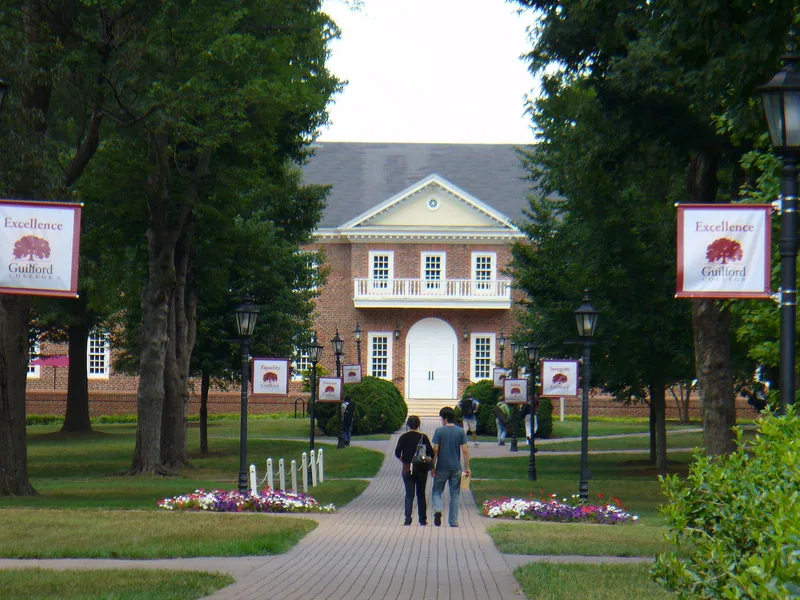
Guilford College occupies a 300-acre tract in Greensboro, North Carolina, about 80 acres of it developed. Its core is a landscaped, tree-shaded quadrangle reached by a straight promenade from Friendly Avenue. Around it stand two-story brick buildings in Colonial Revival and Neo-Classical Revival styles, along with one Gothic Revival building, Archdale Hall, built in 1885. Most of the historic buildings date from 1897 to 1912, and faculty housing was added in the 1930s. The campus grew from the New Garden Boarding School, opened by Quakers in 1837. Its restrained building designs reflect Quaker taste. The eastern part of the property, once farmed by the college as a model farm, remains largely forest and old fields, which sets the campus apart from many other schools. Later buildings and renovations have changed some interiors and added newer structures, but the scale, materials and landscape keep the campus coherent.
Machine-generated summary. This summary was generated by a language model from the official nomination document and has not been reviewed line by line by an editor. It may contain errors. Check the source document before relying on any detail. Source: nomination document (PDF) · catalog entry. Generated October 2026 (model claude-sonnet-5-5, prompt v1.0-2026-10-29).
| Styles | Colonial Revival, Neo-Classical Revival, Gothic Revival |
|---|---|
| Areas of significance | Community Planning and Development, Other, Education, Religion |
| Acreage | 270 |
| Boundary source | NPS cultural-resource GIS polygon |
| Full listing page | Guilford College (property record) |
What listing means for this property
This is a historic district. Buildings within its boundary are either contributing (they add to the district's significance) or non-contributing. Owners of contributing income-producing buildings can claim the 20% federal rehabilitation tax credit; homeowners should look at state credits. National Register districts impose no design review by themselves; a local historic district ordinance, if one exists, does (the difference explained).
General information, not legal or tax advice. Rules change; confirm with your State Historic Preservation Office or a qualified adviser.