Faucett Mill and House

Why it's listed
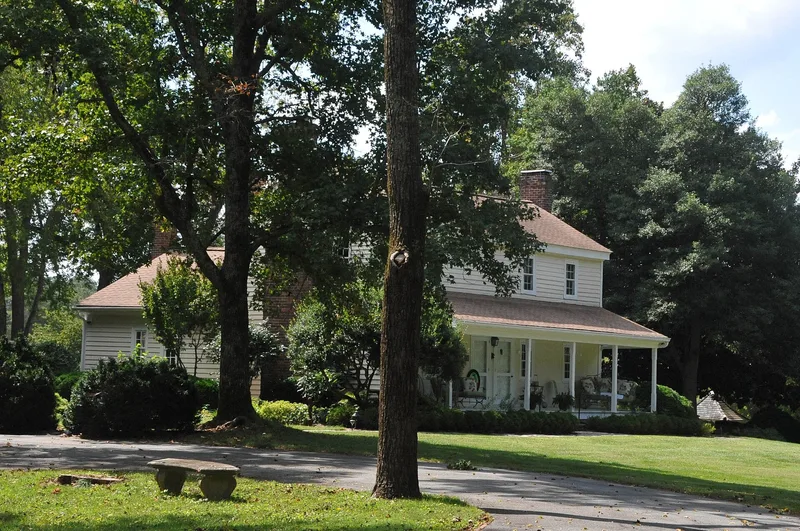
Along a quarter mile of the old Great Road, where it once forded the Eno River northwest of Hillsborough, stand a grist mill, a Federal style house, a mill cottage and a barn. The mill has a hand-hewn heavy timber frame, handmade nails and a dry-laid stone foundation, and it is thought to be the mill documented on the site in 1792. It operated until about 1930 and is the only intact water-powered grist mill in Orange County. The two-and-a-half-story house, built around 1808, is one room deep, with end chimneys, a shed porch and original woodwork. Local tradition holds that it served as a tavern and stagecoach stop until about 1860, and its center hall plan with a second front door into a reputed public room supports that. The house was restored between 1938 and 1940. The complex is regarded as an uncommon surviving mill-tavern pairing in North Carolina.
Machine-generated summary. This summary was generated by a language model from the official nomination document and has not been reviewed line by line by an editor. It may contain errors. Check the source document before relying on any detail. Source: nomination document (PDF) · catalog entry. Generated October 2026 (model claude-sonnet-5-5, prompt v1.0-2026-10-29).
| Period of significance | pre-1792 - ca. 1930 |
|---|---|
| Styles | Federal; heavy timber vernacular (mill) |
| Areas of significance | Commerce, Architecture |
| Acreage | 67 |
| Boundary source | NPS cultural-resource GIS polygon |
| Full listing page | Faucett Mill and House (property record) |
What listing means for this property
This is a historic district. Buildings within its boundary are either contributing (they add to the district's significance) or non-contributing. Owners of contributing income-producing buildings can claim the 20% federal rehabilitation tax credit; homeowners should look at state credits. National Register districts impose no design review by themselves; a local historic district ordinance, if one exists, does (the difference explained).
General information, not legal or tax advice. Rules change; confirm with your State Historic Preservation Office or a qualified adviser.