Elon College Historic District

The National Park Service has not published a boundary polygon for this district; the map shows the listed properties inside it and the district's reference point.
Why it's listed
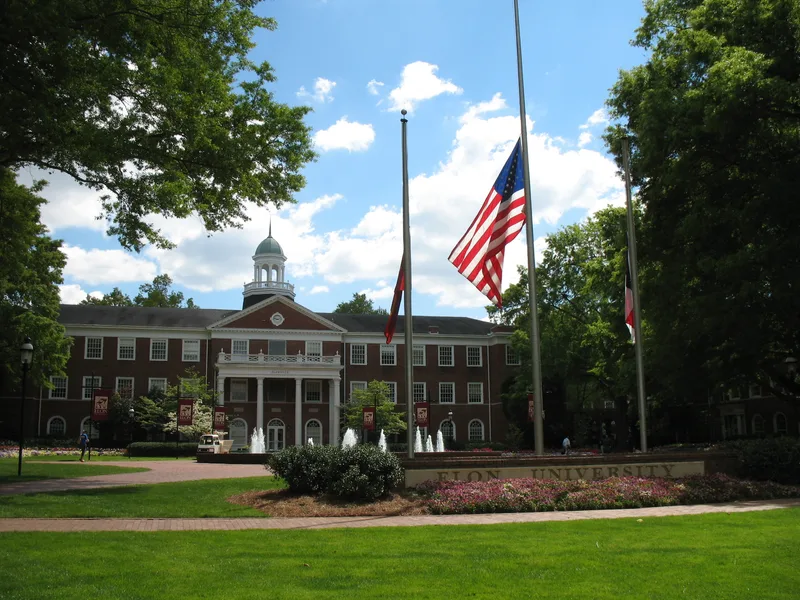
Elon College Historic District covers the historic center of a college campus in Alamance County, North Carolina, midway between Burlington and Greensboro. It holds eight resources: West Dormitory of 1907, five three-story brick buildings built between 1923 and 1927, a 1970 building that does not contribute to the district's character, and an 1929 granite monument to James O'Kelly, founder of the Christian Church. The 1920s buildings, designed by Burlington architect Herbert B. Hunter, form an H-shaped group after a 1923 fire destroyed the Main Building. Alamance Building forms the crossbar, with Whitley, Carlton, Duke and Mooney buildings at right angles, linked by brick arcades. West Dormitory, an early Colonial Revival design with Jacobean touches, is the oldest surviving campus building. The district was listed for its architecture and for its link to Elon College, founded in 1889 as the only four-year college of the Christian Church in the South. The campus continues as a college, and the buildings largely keep their original plans and finishes.
Machine-generated summary. This summary was generated by a language model from the official nomination document and has not been reviewed line by line by an editor. It may contain errors. Check the source document before relying on any detail. Source: nomination document (PDF) · catalog entry. Generated October 2026 (model claude-sonnet-5-5, prompt v1.0-2026-10-29).
| Period of significance | 1907-1931 |
|---|---|
| Styles | Colonial Revival; Georgian Revival |
| Areas of significance | Education, Architecture |
| Acreage | 9 |
| Boundary source | not published |
| Full listing page | Elon College Historic District (property record) |
What listing means for this property
This is a historic district. Buildings within its boundary are either contributing (they add to the district's significance) or non-contributing. Owners of contributing income-producing buildings can claim the 20% federal rehabilitation tax credit; homeowners should look at state credits. National Register districts impose no design review by themselves; a local historic district ordinance, if one exists, does (the difference explained).
General information, not legal or tax advice. Rules change; confirm with your State Historic Preservation Office or a qualified adviser.