Depot Historic District

The National Park Service has not published a boundary polygon for this district; the map shows the listed properties inside it and the district's reference point.
Why it's listed
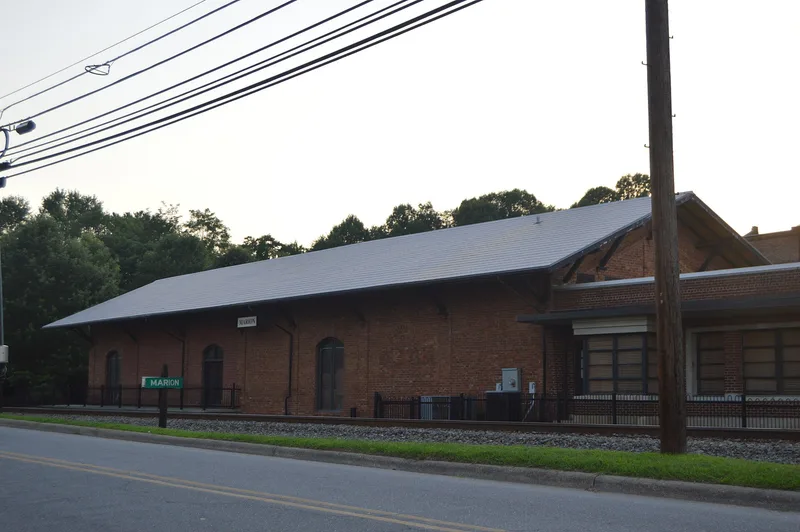
Brick commercial and warehouse buildings cluster along Depot Street and Railroad Street in downtown Marion, built mostly around the turn of the twentieth century and into the 1930s. The district grew up around the Southern Railway depot after the railroad reached Marion in 1870. Its businesses, including wholesale groceries, liquor rectifying, drug manufacturing, hosiery milling, planing mills, and bottling works, relied on rail transport for shipping and supply. The Blanton Wholesale Grocery building, dating from about 1894, has decorative brick corbelling and segmental arches. The four-story Buffaloe Building, built about 1908, is faced with rusticated stone and retains cast iron storefront columns. The freight depot, rebuilt about 1935 in a Craftsman style with broad overhanging eaves, stands at the center. The district is important for its architecture and for its record of the economic boom the railroad produced in Marion.
Machine-generated summary. This summary was generated by a language model from the official nomination document and has not been reviewed line by line by an editor. It may contain errors. Check the source document before relying on any detail. Source: nomination document (PDF) · catalog entry. Generated October 2026 (model claude-haiku-5-5, prompt v1.1-2026-10-29).
| Period of significance | ca. 1894-1937 |
|---|---|
| Styles | Commercial style; Craftsman influence on the depot; vernacular Craftsman |
| Areas of significance | Commerce, Transportation, Architecture |
| Acreage | 2.3 |
| Boundary source | not published |
| Full listing page | Depot Historic District (property record) |
What listing means for this property
This is a historic district. Buildings within its boundary are either contributing (they add to the district's significance) or non-contributing. Owners of contributing income-producing buildings can claim the 20% federal rehabilitation tax credit; homeowners should look at state credits. National Register districts impose no design review by themselves; a local historic district ordinance, if one exists, does (the difference explained).
General information, not legal or tax advice. Rules change; confirm with your State Historic Preservation Office or a qualified adviser.