Central Shelby Historic District

Why it's listed
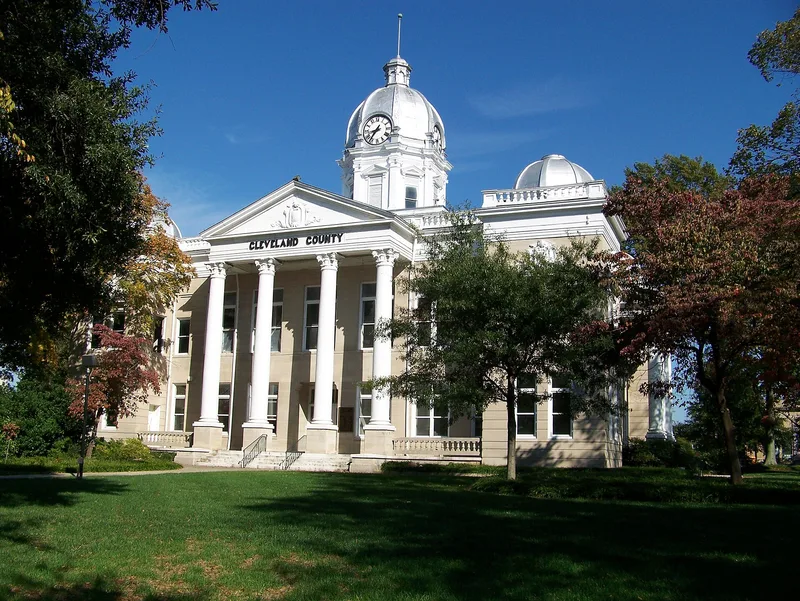
Central Shelby Historic District in Cleveland County, North Carolina, centers on the public square and its 1907 limestone courthouse, which replaced an 1845 brick building. Around it lie the central business district and two residential streets, South Washington and West Marion, once home to the town's leading merchants, professionals and industrialists. Shelby's founders laid out wide streets in a grid, inspired by Washington, D.C., so the streets and mature trees have survived without widening. The buildings span about a century of styles. Surviving mid-nineteenth-century houses blend piedmont vernacular with Greek Revival, followed by Second Empire houses, Colonial Revival residences and many bungalows. Downtown, two-story brick commercial blocks replaced frame stores from the 1880s, with the Washburn Block the best intact example. Other landmarks include the yellow brick First Baptist Church, the Royster Building and an Egyptian Revival Masonic Temple. Deep lawns, shade trees and uniform setbacks give the neighborhoods continuity, and the district's overall character has changed little since World War II.
Machine-generated summary. This summary was generated by a language model from the official nomination document and has not been reviewed line by line by an editor. It may contain errors. Check the source document before relying on any detail. Source: nomination document (PDF) · catalog entry. Generated October 2026 (model claude-sonnet-5-5, prompt v1.0-2026-10-29).
| Styles | Mixed: Greek Revival, Second Empire, Colonial Revival, Bungaloid, Gothic Revival, Egyptian Revival, and brick commercial styles |
|---|---|
| Areas of significance | Commerce, Literature, Politics/Government, Architecture, Communications |
| Acreage | 150 |
| Boundary source | NPS cultural-resource GIS polygon |
| Full listing page | Central Shelby Historic District (property record) |
What listing means for this property
This is a historic district. Buildings within its boundary are either contributing (they add to the district's significance) or non-contributing. Owners of contributing income-producing buildings can claim the 20% federal rehabilitation tax credit; homeowners should look at state credits. National Register districts impose no design review by themselves; a local historic district ordinance, if one exists, does (the difference explained).
General information, not legal or tax advice. Rules change; confirm with your State Historic Preservation Office or a qualified adviser.