Bodie Island Light Station

Why it's listed
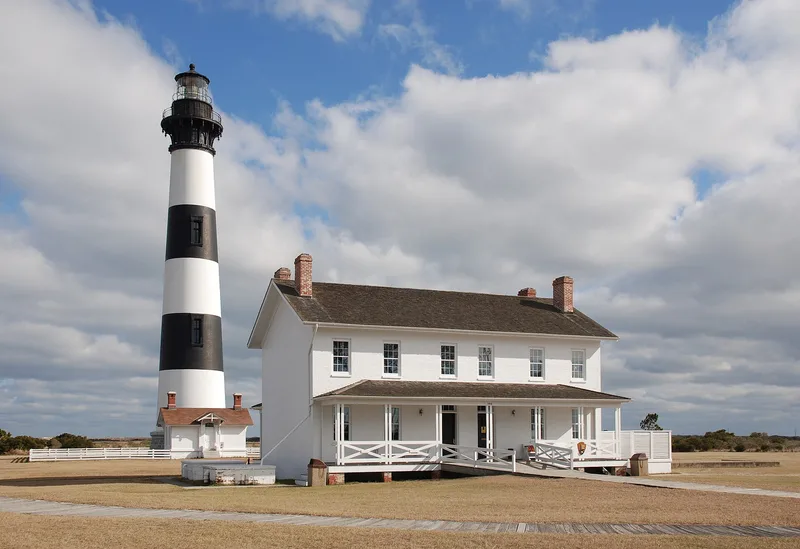
Bodie Island Light Station, in Dare County on North Carolina's Outer Banks, centers on a tall brick lighthouse completed in 1872. The tower follows a standardized U.S. Lighthouse Board design for stand-alone conical first-order towers. Inside, a 214-step cast-iron spiral staircase rises through eight landings to the lantern, and the floor at the base is marble tile laid in a diamond checkerboard pattern. The first-order lens was made by Barbier and Fenestre of Paris in 1871 and still serves, with a modern electric lamp, as an active aid to navigation maintained by the U.S. Coast Guard. A white brick oil house and workroom is attached to the tower by a short passageway and has a Stick Style gabled stoop. The tower passed to the National Park Service in 2000, though the Coast Guard kept ownership of the lens. The excerpt provided does not include the formal statement of significance.
Machine-generated summary. This summary was generated by a language model from the official nomination document and has not been reviewed line by line by an editor. It may contain errors. Check the source document before relying on any detail. Source: nomination document (PDF) · catalog entry. Generated October 2026 (model claude-sonnet-5-5, prompt v1.0-2026-10-29).
| Styles | Stick Style is mentioned for the oil house stoop overhang; no overall style classification is stated. |
|---|---|
| Areas of significance | Architecture, Engineering, Maritime History, Transportation |
| Acreage | 15 |
| Boundary source | NPS cultural-resource GIS polygon |
| Full listing page | Bodie Island Light Station (property record) |
What listing means for this property
This is a historic district. Buildings within its boundary are either contributing (they add to the district's significance) or non-contributing. Owners of contributing income-producing buildings can claim the 20% federal rehabilitation tax credit; homeowners should look at state credits. National Register districts impose no design review by themselves; a local historic district ordinance, if one exists, does (the difference explained).
General information, not legal or tax advice. Rules change; confirm with your State Historic Preservation Office or a qualified adviser.