Bethania Historic District

Why it's listed
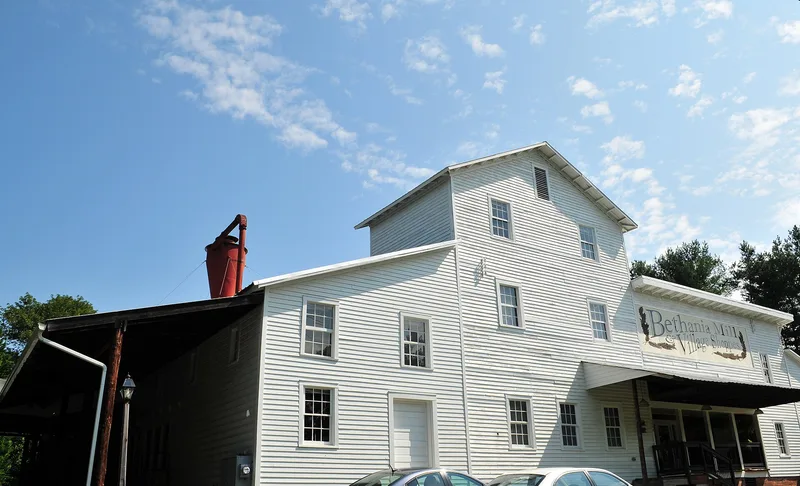
Bethania in Forsyth County, North Carolina, is a village founded in 1759 as a self-sufficient Moravian farming community. The district takes in the whole village, which in 1975 was no larger than at its nineteenth-century peak. Of its thirty-four buildings, thirteen predate the Civil War. The original plan survives: house lots flank a single main street, with a cemetery called God's Acre east of the former square and garden lots beyond. Two-story houses with fieldstone foundations, white clapboard walls, steep gable roofs and shed-roofed porches sit against a fieldstone sidewalk. They are dominated by the brick Moravian church, built 1806-1809 and rebuilt within its walls after a 1942 fire. The houses include log buildings and frame houses with brick nogging, many remodeled around 1850. One house has parlor wall paintings attributed to Naaman Reich. Only one building, a ca. 1930 commercial structure, is considered an intrusion. Moravian church records document the town's history.
Machine-generated summary. This summary was generated by a language model from the official nomination document and has not been reviewed line by line by an editor. It may contain errors. Check the source document before relying on any detail. Source: nomination document (PDF) · catalog entry. Generated October 2026 (model claude-sonnet-5-5, prompt v1.0-2026-10-29).
| Styles | Moravian town planning with Federal and Greek Revival influences; houses grouped by construction type (log, brick-nogged frame, wood frame) |
|---|---|
| Areas of significance | Community Planning and Development, Architecture, Religion, Social History |
| Acreage | 50 |
| Boundary source | NPS cultural-resource GIS polygon |
| Full listing page | Bethania Historic District (property record) |
What listing means for this property
This is a historic district. Buildings within its boundary are either contributing (they add to the district's significance) or non-contributing. Owners of contributing income-producing buildings can claim the 20% federal rehabilitation tax credit; homeowners should look at state credits. National Register districts impose no design review by themselves; a local historic district ordinance, if one exists, does (the difference explained).
General information, not legal or tax advice. Rules change; confirm with your State Historic Preservation Office or a qualified adviser.