Bank of Onslow and Jacksonville Masonic Temple

The National Park Service has not published a boundary polygon for this district; the map shows the listed properties inside it and the district's reference point.
Why it's listed
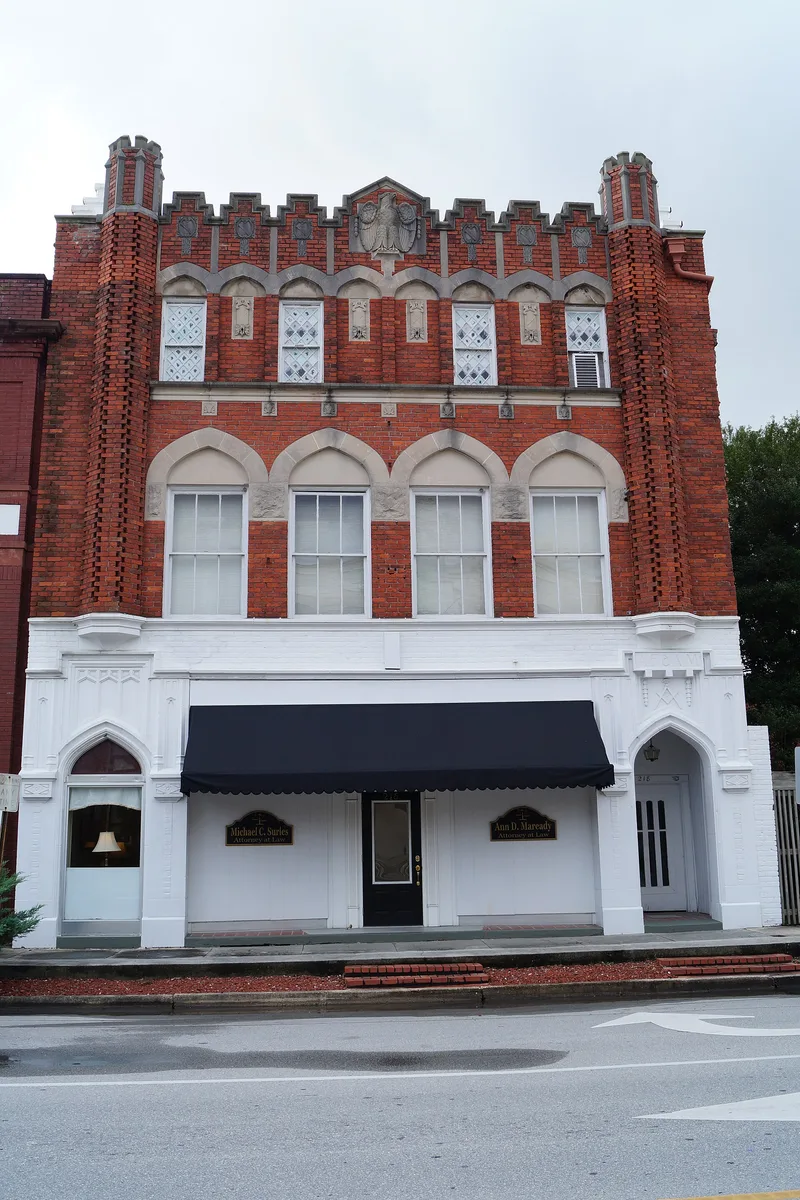
Two neighboring brick buildings on Old Bridge Street, across from the Onslow County courthouse square, form this small downtown Jacksonville district. The Bank of Onslow, built around 1916, has a monumental Beaux Arts facade with giant pilasters, a heavy cornice and decorative brickwork. Next door, the 1919 Jacksonville Masonic Temple is a Tudor Revival building with crenelations, lancet arches, concrete sculpture and octagonal turrets. Wilmington architect Henry E. Bonitz designed the temple, and Crumpler Brothers of Warsaw built it. He may also have designed the bank. The bank, founded in 1904 as Jacksonville's first, sold its building in 1937 to First Citizens Bank and Trust Company. The temple housed LaFayette Lodge No. 83, other fraternal groups, lawyers and a retail store until the lodge defaulted in 1941. Both buildings are listed for their architectural quality and their role in the town's commercial and social history.
Machine-generated summary. This summary was generated by a language model from the official nomination document and has not been reviewed line by line by an editor. It may contain errors. Check the source document before relying on any detail. Source: nomination document (PDF) · catalog entry. Generated October 2026 (model claude-sonnet-5-5, prompt v1.0-2026-10-29).
| Period of significance | ca. 1916-1939 |
|---|---|
| Styles | Beaux Arts; Tudor Revival |
| Areas of significance | Commerce, Architecture, Social History |
| Acreage | 0.1 |
| Boundary source | not published |
| Full listing page | Bank of Onslow and Jacksonville Masonic Temple (property record) |
What listing means for this property
This is a historic district. Buildings within its boundary are either contributing (they add to the district's significance) or non-contributing. Owners of contributing income-producing buildings can claim the 20% federal rehabilitation tax credit; homeowners should look at state credits. National Register districts impose no design review by themselves; a local historic district ordinance, if one exists, does (the difference explained).
General information, not legal or tax advice. Rules change; confirm with your State Historic Preservation Office or a qualified adviser.