Zion Episcopal Church Complex and Harmony Cemetery

The National Park Service has not published a boundary polygon for this district; the map shows the listed properties inside it and the district's reference point.
Why it's listed
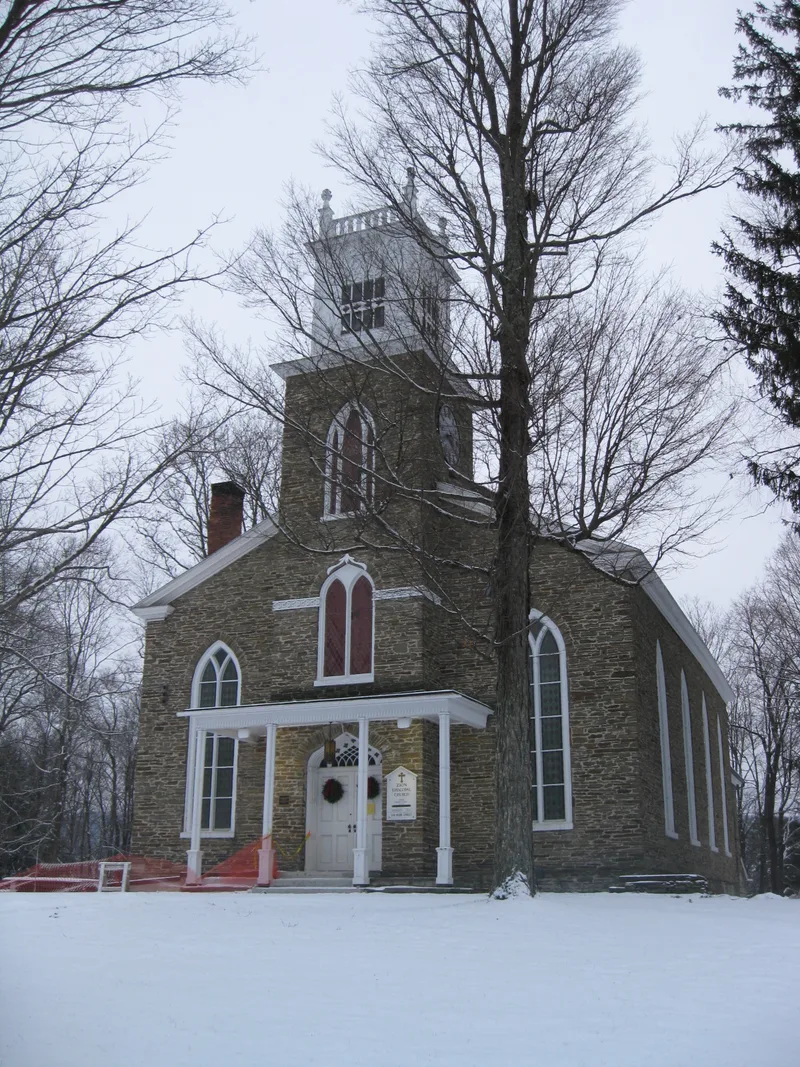
Zion Episcopal Church Complex in Morris, New York, combines an 1818 stone church, an 1893 rectory and a 1901 parish house on East Main Street with Harmony Cemetery, a two-acre burial ground about one and one-half miles away on Pegg Road. The cemetery marks the site of the parish's first church, built around 1801, and holds burials from c1800 to 1937. The village church was built on land donated by General Jacob Morris and follows the early English Gothic Revival style, with lancet-arched windows and a projecting stone tower topped by a wooden belfry. It may have been modeled on Trinity Church in New Haven, Connecticut. A chancel was added around 1867, and the interior was redone in a Victorian manner. The rectory and parish house survive as intact examples of their eras. Together the four resources record nearly two centuries of religious and social life in the community, which is why the complex was recognized for its role in local settlement and its architecture.
Machine-generated summary. This summary was generated by a language model from the official nomination document and has not been reviewed line by line by an editor. It may contain errors. Check the source document before relying on any detail. Source: nomination document (PDF) · catalog entry. Generated October 2026 (model claude-sonnet-5-5, prompt v1.0-2026-10-29).
| Period of significance | c1800-c1901 |
|---|---|
| Styles | Gothic Revival, Late 19th and 20th Century Revivals |
| Areas of significance | Exploration/Settlement, Architecture |
| Acreage | 6 |
| Boundary source | not published |
| Full listing page | Zion Episcopal Church Complex and Harmony Cemetery (property record) |
What listing means for this property
This is a historic district. Buildings within its boundary are either contributing (they add to the district's significance) or non-contributing. Owners of contributing income-producing buildings can claim the 20% federal rehabilitation tax credit; homeowners should look at state credits. National Register districts impose no design review by themselves; a local historic district ordinance, if one exists, does (the difference explained).
General information, not legal or tax advice. Rules change; confirm with your State Historic Preservation Office or a qualified adviser.