Ward, M. J., Feed Mill Complex

The National Park Service has not published a boundary polygon for this district; the map shows the listed properties inside it and the district's reference point.
Why it's listed
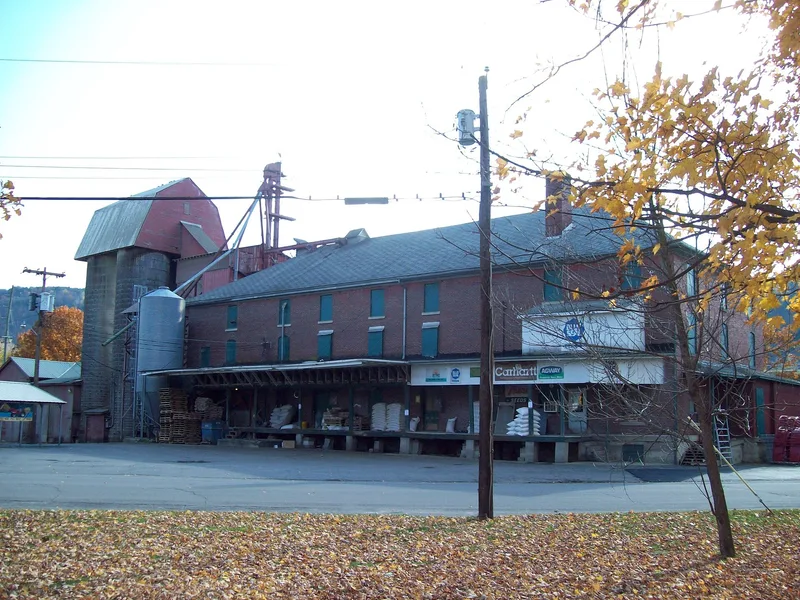
Close to the railroad tracks at the southeast corner of Cameron and Morris Streets in Bath, this small complex centers on a three-story brick feed mill and farm store built in 1909. The stud-framed building has a brick veneer, a hipped roof and a deep concrete basement. Its long plan follows a rail siding, with freight doors and a pit for receiving bulk feed directly from railroad cars. Open interior floors have allowed equipment and storage to change over time. Nearby are a balloon-framed barn of about 1870, once a wagon and paint shop and moved in 1956, and an Italianate house of the same period that served the Ward family and later mill employees. Grain bins and silos added in 1976, and a concrete block storage building, are noncontributing. The group is considered locally significant as a well-preserved example of a small-town rail-served feed mill. Three generations of the Ward family have owned it since 1932, and its patterned brickwork marks a visible entrance to the village.
Machine-generated summary. This summary was generated by a language model from the official nomination document and has not been reviewed line by line by an editor. It may contain errors. Check the source document before relying on any detail. Source: nomination document (PDF) · catalog entry. Generated October 2026 (model claude-sonnet-5-5, prompt v1.0-2026-10-29).
| Period of significance | 1909-c1932 |
|---|---|
| Styles | No style/multi-story commercial brick; Italianate (residence) |
| Areas of significance | Commerce, Architecture |
| Acreage | 0.9 |
| Boundary source | not published |
| Full listing page | Ward, M. J., Feed Mill Complex (property record) |
What listing means for this property
This is a historic district. Buildings within its boundary are either contributing (they add to the district's significance) or non-contributing. Owners of contributing income-producing buildings can claim the 20% federal rehabilitation tax credit; homeowners should look at state credits. National Register districts impose no design review by themselves; a local historic district ordinance, if one exists, does (the difference explained).
General information, not legal or tax advice. Rules change; confirm with your State Historic Preservation Office or a qualified adviser.