Waddington Historic District

The National Park Service has not published a boundary polygon for this district; the map shows the listed properties inside it and the district's reference point.
Why it's listed
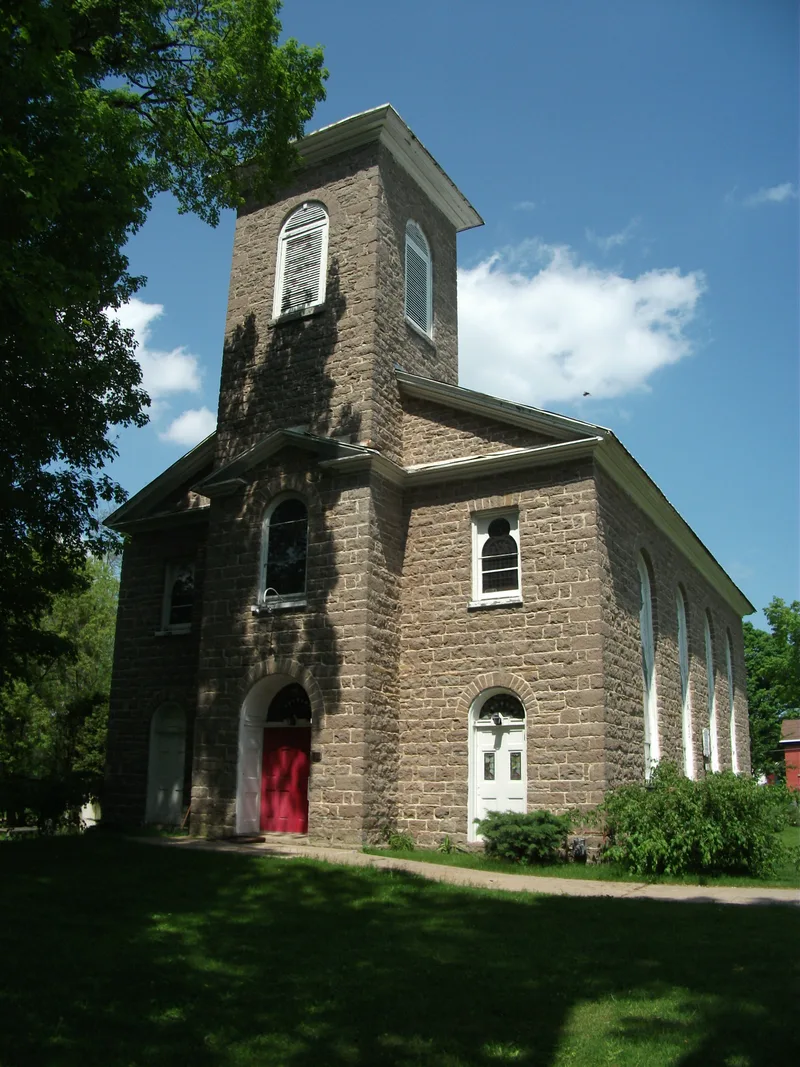
Eleven buildings line LaGrasse Street at the southern end of Waddington's business core, near the St. Lawrence River. Dating from 1816 to 1919, they include eight residences, a town hall, a library and a church. The earliest are three limestone Federal-style buildings: St. Paul's Episcopal Church, the James Thayer House and the George Redington House, which share similar rock-faced ashlar masonry. St. Paul's, planned by French architect Joseph-Jacques Ramee and finished in 1818, is described as the oldest surviving church building in St. Lawrence County. The 1884 stone Town Hall has two massive corner towers, and the 1919 brick Hepburn Library is a Classical Revival building with a monumental portico and Palladian windows. Greek Revival, Italianate and Queen Anne houses and modest vernacular dwellings fill out the street. Together they show how the village grew from an early water-powered settlement into a farm-region commercial center, and they keep a cohesive nineteenth-century streetscape.
Machine-generated summary. This summary was generated by a language model from the official nomination document and has not been reviewed line by line by an editor. It may contain errors. Check the source document before relying on any detail. Source: nomination document (PDF) · catalog entry. Generated October 2026 (model claude-sonnet-5-5, prompt v1.0-2026-10-29).
| Period of significance | 1818-1919 |
|---|---|
| Styles | Federal, Greek Revival, Italianate, Queen Anne, Classical Revival, No Style |
| Areas of significance | Education, Politics/Government, Architecture, Religion, Social History |
| Acreage | 6 |
| Boundary source | not published |
| Full listing page | Waddington Historic District (property record) |
What listing means for this property
This is a historic district. Buildings within its boundary are either contributing (they add to the district's significance) or non-contributing. Owners of contributing income-producing buildings can claim the 20% federal rehabilitation tax credit; homeowners should look at state credits. National Register districts impose no design review by themselves; a local historic district ordinance, if one exists, does (the difference explained).
General information, not legal or tax advice. Rules change; confirm with your State Historic Preservation Office or a qualified adviser.