von Steuben, Baron, Memorial Site

Why it's listed
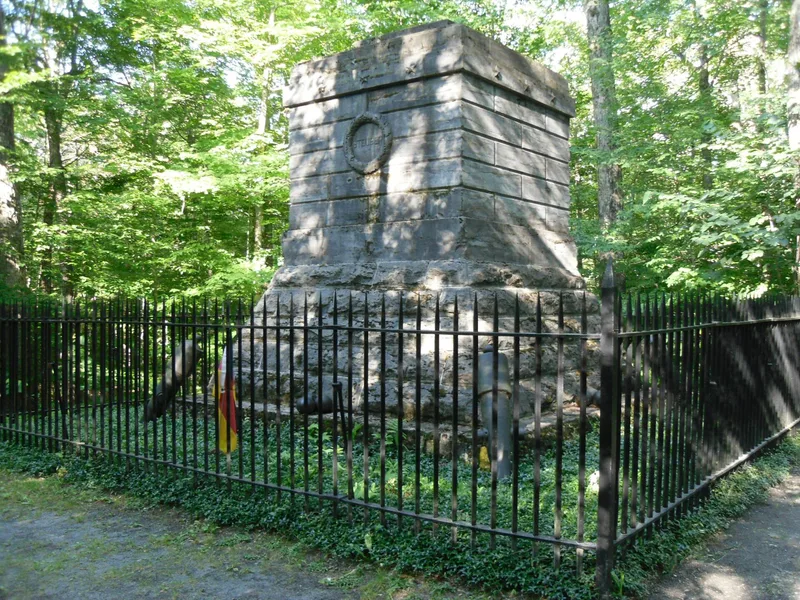
Baron von Steuben Memorial Site in Remsen, Oneida County, marks the burial place of Friedrich Wilhelm von Steuben, the Prussian officer who trained Continental Army troops at Valley Forge. The site centers on a granite and limestone tomb, completed in 1872 and surrounded by an iron fence, Civil War era Parrott guns and stacked cannonballs. Nearby are a 1937 reconstructed log cabin, a boulder bearing a 1934 bronze plaque, eight 1930s state historic markers and rows of Norway spruces planted in 1932. The tomb sits within a five-acre wooded Sacred Grove that must remain forested under the terms of its deed. The property was listed for its role in German-American social history. German-Americans gathered here in the 1870s and again in the interwar years, when Steuben's unquestioned patriotism let them affirm loyalty after the suspicion of World War I. They worked with New York State to acquire the land, develop the park and build the cabin, and the site remained a place where being German was acceptable.
Machine-generated summary. This summary was generated by a language model from the official nomination document and has not been reviewed line by line by an editor. It may contain errors. Check the source document before relying on any detail. Source: nomination document (PDF) · catalog entry. Generated October 2026 (model claude-sonnet-5-5, prompt v1.0-2026-10-29).
| Period of significance | 1804-1945 |
|---|---|
| Styles | No style |
| Areas of significance | Social History |
| Acreage | 53 |
| Boundary source | NPS cultural-resource GIS polygon |
| Full listing page | von Steuben, Baron, Memorial Site (property record) |
What listing means for this property
This is a historic district. Buildings within its boundary are either contributing (they add to the district's significance) or non-contributing. Owners of contributing income-producing buildings can claim the 20% federal rehabilitation tax credit; homeowners should look at state credits. National Register districts impose no design review by themselves; a local historic district ordinance, if one exists, does (the difference explained).
General information, not legal or tax advice. Rules change; confirm with your State Historic Preservation Office or a qualified adviser.