Village Park Historic District

The National Park Service has not published a boundary polygon for this district; the map shows the listed properties inside it and the district's reference point.
Why it's listed
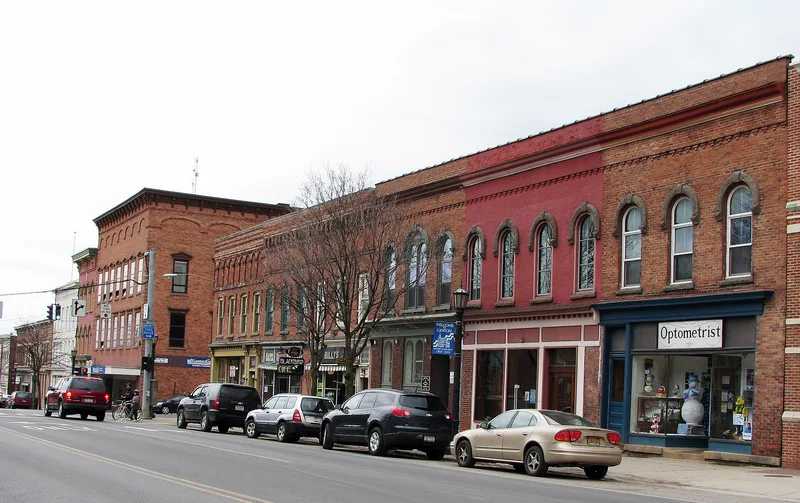
Canton's Village Park Historic District centers on a trapezoidal village park with a stone fountain and mature trees. Around it stand three churches, the Benton Memorial Library, a 1936 post office, a row of six brick commercial buildings from the 1870s, a savings bank and several residences. The granite Presbyterian Church, designed by L. B. Valk and built from 1876 to 1880, dominates the south side. The oldest building is the 1834 Silas Wright House. Wright, a lawyer who became state senator, congressman, U.S. Senator and Governor of New York, donated the park with partner Joseph Barnes in 1827, along with the site for the Presbyterian Church. Most buildings are late Victorian, and the rebuilding of the churches in the late nineteenth century reflects the village's growth, partly tied to nearby St. Lawrence University. A few modern additions and an ice cream stand are noted as intrusions, but the district otherwise keeps a consistent arrangement of buildings and open space.
Machine-generated summary. This summary was generated by a language model from the official nomination document and has not been reviewed line by line by an editor. It may contain errors. Check the source document before relying on any detail. Source: nomination document (PDF) · catalog entry. Generated October 2026 (model claude-sonnet-5-5, prompt v1.0-2026-10-29).
| Period of significance | 1800-1899, 1900- |
|---|---|
| Styles | Late Victorian; Romanesque Revival (Unitarian-Universalist Church); Gothic (Presbyterian and Baptist churches); neo-classical (library); Colonial Revival (post office) |
| Areas of significance | Community Planning and Development, Politics/Government, Architecture |
| Acreage | 9.5 |
| Boundary source | not published |
| Full listing page | Village Park Historic District (property record) |
What listing means for this property
This is a historic district. Buildings within its boundary are either contributing (they add to the district's significance) or non-contributing. Owners of contributing income-producing buildings can claim the 20% federal rehabilitation tax credit; homeowners should look at state credits. National Register districts impose no design review by themselves; a local historic district ordinance, if one exists, does (the difference explained).
General information, not legal or tax advice. Rules change; confirm with your State Historic Preservation Office or a qualified adviser.