Trinity Church Lansingburgh

The National Park Service has not published a boundary polygon for this district; the map shows the listed properties inside it and the district's reference point.
Why it's listed
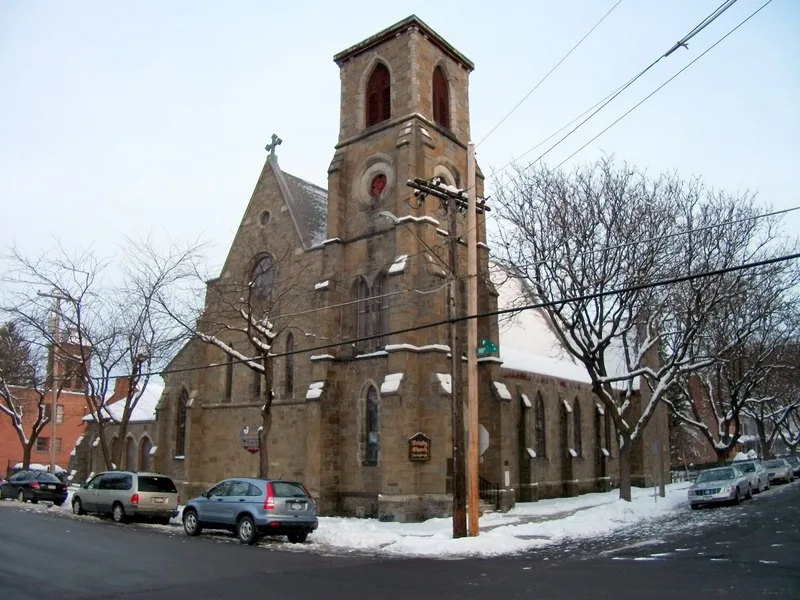
Trinity Church Complex occupies about two-thirds of an acre at 585 Fourth Avenue in Lansingburgh, a planned village laid out in 1770-71 and annexed by Troy in 1901. The Episcopal congregation organized in 1804, and the site includes a cemetery begun in 1807, a brick Greek Revival rectory from about 1844, a bluestone Gothic Revival church built in 1869 after fire destroyed the original, a wrought-iron fence from 1901, and a parish hall of 1930. Architect Henry Dudley, English-born and trained, designed the church with a steeply pitched roof, buttresses, lancet windows and stone construction typical of an English parish church. The graveyard contains over 240 graves, including prominent local residents and Revolutionary War veterans. Together the buildings and green space form a visible timeline of the congregation's development. The complex was listed for its architecture and its high degree of integrity.
Machine-generated summary. This summary was generated by a language model from the official nomination document and has not been reviewed line by line by an editor. It may contain errors. Check the source document before relying on any detail. Source: nomination document (PDF) · catalog entry. Generated October 2026 (model claude-sonnet-5-5, prompt v1.0-2026-10-29).
| Period of significance | 1807-1930 |
|---|---|
| Styles | Gothic Revival; Greek Revival |
| Areas of significance | Architecture |
| Acreage | 0.9 |
| Boundary source | not published |
| Full listing page | Trinity Church Lansingburgh (property record) |
What listing means for this property
This is a historic district. Buildings within its boundary are either contributing (they add to the district's significance) or non-contributing. Owners of contributing income-producing buildings can claim the 20% federal rehabilitation tax credit; homeowners should look at state credits. National Register districts impose no design review by themselves; a local historic district ordinance, if one exists, does (the difference explained).
General information, not legal or tax advice. Rules change; confirm with your State Historic Preservation Office or a qualified adviser.