Thousand Island Park Historic District (Boundary Increase/Decrease)

The National Park Service has not published a boundary polygon for this district; the map shows the listed properties inside it and the district's reference point.
Why it's listed
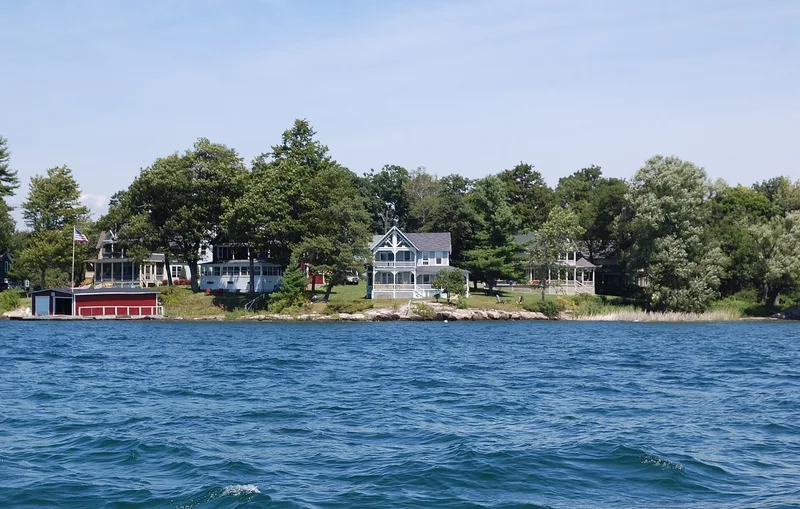
Thousand Island Park occupies the southwest end of Wellesley Island in the St. Lawrence River. Founded in 1875 by the Rev. John Ferdinand Dayan as a Methodist campground meant to encourage social interaction between Americans and Canadians, it began as a colony of tents and grew into a village of closely spaced frame cottages with open verandas, arranged along walks that converge on a village green. By 1890 it had nearly 600 cottages and 7,000 summer residents. A fire in 1912 destroyed the Columbia Hotel and about a hundred other structures, most of which were not rebuilt. Today 305 structures survive, with early Gothic-influenced cottages, Queen Anne houses, and Neoclassical and Colonial Revival buildings such as the library. The district was listed for its intact resort architecture and for its social history, including Swami Vivekananda's 1894 stay. Only eleven modern buildings do not contribute to its historic character.
Machine-generated summary. This summary was generated by a language model from the official nomination document and has not been reviewed line by line by an editor. It may contain errors. Check the source document before relying on any detail. Source: nomination document (PDF) · catalog entry. Generated October 2026 (model claude-sonnet-5-5, prompt v1.0-2026-10-29).
| Period of significance | 1875-1920 |
|---|---|
| Styles | Gothic, Eastlake, Queen Anne, Neoclassical and Colonial Revival resort architecture |
| Areas of significance | Architecture, Religion |
| Boundary source | not published |
| Full listing page | Thousand Island Park Historic District (Boundary Increase/Decrease) (property record) |
What listing means for this property
This is a historic district. Buildings within its boundary are either contributing (they add to the district's significance) or non-contributing. Owners of contributing income-producing buildings can claim the 20% federal rehabilitation tax credit; homeowners should look at state credits. National Register districts impose no design review by themselves; a local historic district ordinance, if one exists, does (the difference explained).
General information, not legal or tax advice. Rules change; confirm with your State Historic Preservation Office or a qualified adviser.