Thousand Island Park Historic District (Additional Documentation)

Why it's listed
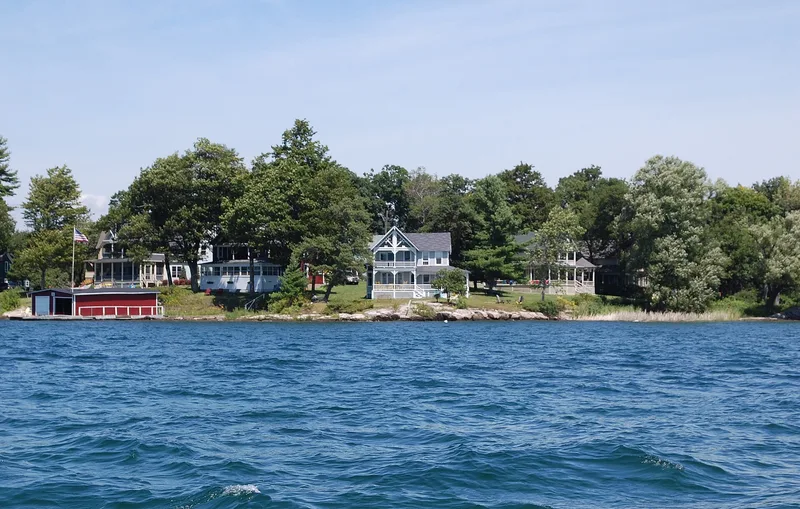
Thousand Island Park is a planned summer colony covering 145 acres at the southwest end of Wellesley Island in the St. Lawrence River. Founded in 1875 by Rev. John Ferdinand Dayan as a Methodist camp association, it began as a settlement of tents and quickly became a village of frame cottages. Today 305 structures remain, nearly all summer residences with open verandas, set on narrow lots along walkways and around a village green. Styles run from 1870s Gothic cottages with Eastlake detail, such as the Sweetheart Cottage and the metal-sided Iron Cottage, to larger Queen Anne houses and early twentieth century Neoclassical and Colonial Revival buildings, including a Georgian-style library. The park grew to nearly 600 cottages and 7,000 summer residents by 1890. Visitors included Swami Vivekananda in 1894, as well as Carrie Nation and Frances Willard. It is listed as the region's largest and best preserved religious colony of its era.
Machine-generated summary. This summary was generated by a language model from the official nomination document and has not been reviewed line by line by an editor. It may contain errors. Check the source document before relying on any detail. Source: nomination document (PDF) · catalog entry. Generated October 2026 (model claude-sonnet-5-5, prompt v1.0-2026-10-29).
| Period of significance | 1875-1920 |
|---|---|
| Styles | Gothic, Eastlake, Queen Anne, Neoclassical, and Colonial Revival |
| Areas of significance | Architecture, Religion |
| Acreage | 176 |
| Boundary source | NPS cultural-resource GIS polygon |
| Full listing page | Thousand Island Park Historic District (Additional Documentation) (property record) |
What listing means for this property
This is a historic district. Buildings within its boundary are either contributing (they add to the district's significance) or non-contributing. Owners of contributing income-producing buildings can claim the 20% federal rehabilitation tax credit; homeowners should look at state credits. National Register districts impose no design review by themselves; a local historic district ordinance, if one exists, does (the difference explained).
General information, not legal or tax advice. Rules change; confirm with your State Historic Preservation Office or a qualified adviser.