Stockholm-DeKalb-Hart Historic District

The National Park Service has not published a boundary polygon for this district; the map shows the listed properties inside it and the district's reference point.
Why it's listed
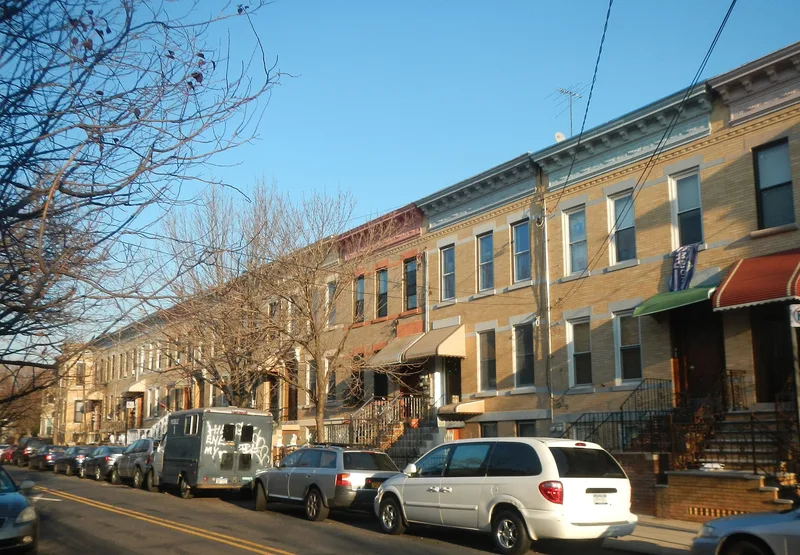
Seventy-nine row houses along Stockholm Street, DeKalb Avenue and Hart Street in Ridgewood, Queens, form a compact district built between 1905 and 1921 next to Linden Hill Cemetery. Most are two-story brick buildings with one apartment per floor, finished in iron-spot brick with cast-stone trim, pressed metal cornices and ornate ironwork. Stockholm Street stands out for its light brown cobblestone pavement, the only surviving cobblestone street in Ridgewood, and for continuous rows of three-bay porches with Tuscan columns. The towers of nearby Saint Aloysius Church close the view at the street's western end. Builders Joseph Weiss, John E. Ballweg, John M. Meyer and Jacob Jaeger cooperated on uniform setbacks, scale and materials, and Louis Berger and Co., Ridgewood's most prolific architectural firm, designed every row. The district was recognized as an intact example of working-class housing from the neighborhood's main development period, with changes limited mostly to new doors, stoops and awnings.
Machine-generated summary. This summary was generated by a language model from the official nomination document and has not been reviewed line by line by an editor. It may contain errors. Check the source document before relying on any detail. Source: nomination document (PDF) · catalog entry. Generated October 2026 (model claude-sonnet-5-5, prompt v1.0-2026-10-29).
| Period of significance | 1905-1921 |
|---|---|
| Styles | Renaissance Revival and Romanesque Revival detailing, with some Neo Grec Revival |
| Areas of significance | Architecture |
| Acreage | 5.5 |
| Boundary source | not published |
| Full listing page | Stockholm-DeKalb-Hart Historic District (property record) |
What listing means for this property
This is a historic district. Buildings within its boundary are either contributing (they add to the district's significance) or non-contributing. Owners of contributing income-producing buildings can claim the 20% federal rehabilitation tax credit; homeowners should look at state credits. National Register districts impose no design review by themselves; a local historic district ordinance, if one exists, does (the difference explained).
General information, not legal or tax advice. Rules change; confirm with your State Historic Preservation Office or a qualified adviser.