Sonnenberg Gardens

Why it's listed
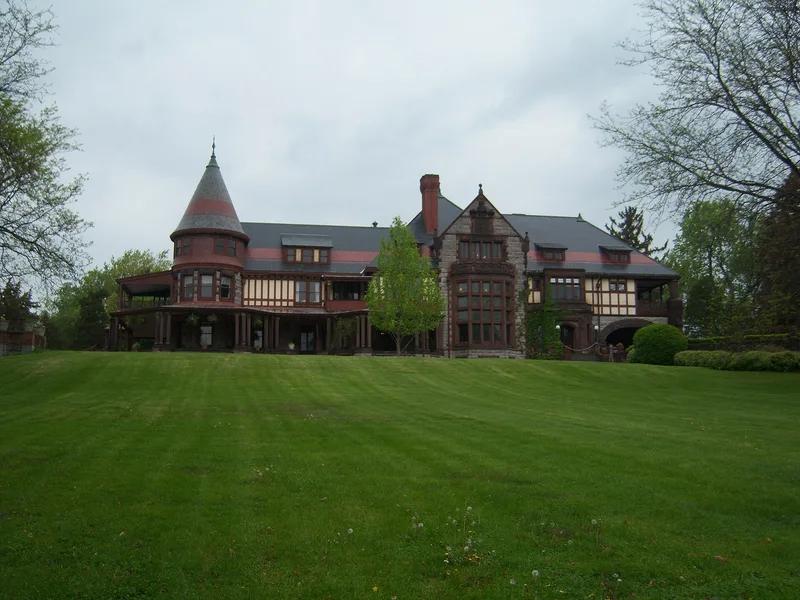
Sonnenberg Gardens is a 40-acre estate on the eastern edge of Canandaigua, New York, behind a thick masonry wall. It holds lawns, a deer park, a large stone-and-shingle house built in 1887, and eight distinct gardens: Italian, Rose, Sub-Rosa, Blue and White, Pansy, Old-Fashioned, Rock and Japanese. Frederick Ferris Thompson and Mary Clark Thompson bought the land in 1863. After his death in 1899, Mrs. Thompson had the grounds redesigned around 1900 by landscape architect Ernest Bowditch, and a Japanese designer, K. Wadamori, planned the Japanese Garden. The nomination values the estate for its architecture, landscape design and sculpture, and for the rare scale and preservation of its gardens. A Veterans Administration hospital bought the property in 1931 and kept up the gardens as part of patient rehabilitation. In 1972 the house and gardens passed to a non-profit corporation, and in 1973 they opened permanently to the public.
Machine-generated summary. This summary was generated by a language model from the official nomination document and has not been reviewed line by line by an editor. It may contain errors. Check the source document before relying on any detail. Source: nomination document (PDF) · catalog entry. Generated October 2026 (model claude-sonnet-5-5, prompt v1.0-2026-10-29).
| Period of significance | 1887 (house), c. 1900 (gardens); 19th and 20th centuries |
|---|---|
| Styles | Richardsonian house |
| Areas of significance | Landscape Architecture, Architecture |
| Acreage | 40 |
| Boundary source | NPS cultural-resource GIS polygon |
| Full listing page | Sonnenberg Gardens (property record) |
What listing means for this property
This is a historic district. Buildings within its boundary are either contributing (they add to the district's significance) or non-contributing. Owners of contributing income-producing buildings can claim the 20% federal rehabilitation tax credit; homeowners should look at state credits. National Register districts impose no design review by themselves; a local historic district ordinance, if one exists, does (the difference explained).
General information, not legal or tax advice. Rules change; confirm with your State Historic Preservation Office or a qualified adviser.