Skaneateles Historic District

Why it's listed
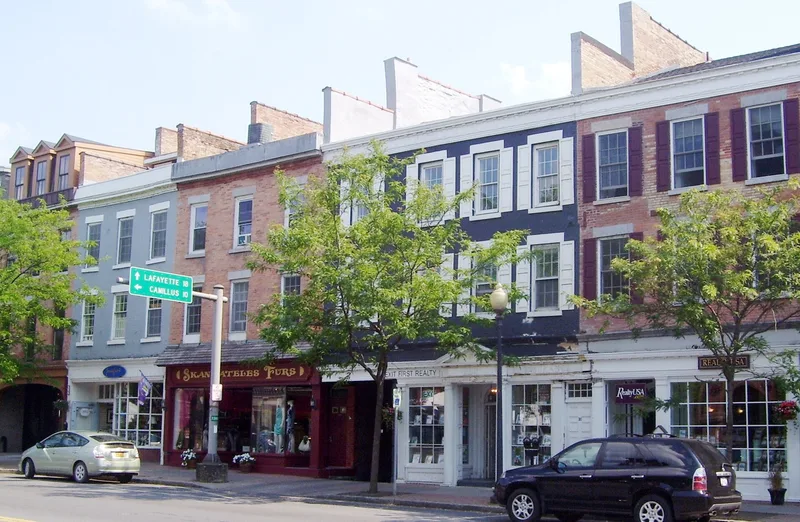
Skaneateles Historic District is the central business district and adjoining residential neighborhood of a lakeside village in Onondaga County, New York. It includes fifty-nine structures and a park along East Genesee Street, the adjacent block of Jordan Street, and an 1842 stone mill on Fennell Street. The west half is dominated by a continuous row of seventeen three- and four-story Greek Revival brick commercial buildings, erected in 1836 on the site of the earlier business center destroyed by fire in 1835. Across the street stand later shops, a bank with a clock tower, and a Romanesque Revival library of 1887. The east half holds early nineteenth-century houses, including several Federal-style homes, two masonry churches from 1873 and 1890, and Thayer-Austin Park, a former private garden given to the village in 1922. The district was listed for its well-preserved collection of buildings spanning 1796 to 1928, which together show how the village grew as a mercantile and manufacturing center.
Machine-generated summary. This summary was generated by a language model from the official nomination document and has not been reviewed line by line by an editor. It may contain errors. Check the source document before relying on any detail. Source: nomination document (PDF) · catalog entry. Generated October 2026 (model claude-sonnet-5-5, prompt v1.0-2026-10-29).
| Period of significance | 1796-1928 |
|---|---|
| Styles | Federal and Greek Revival with Italianate modifications, plus Second Empire, Romanesque Revival, Queen Anne, Shingle and Modernistic examples |
| Areas of significance | Architecture |
| Acreage | 17 |
| Boundary source | NPS cultural-resource GIS polygon |
| Full listing page | Skaneateles Historic District (property record) |
What listing means for this property
This is a historic district. Buildings within its boundary are either contributing (they add to the district's significance) or non-contributing. Owners of contributing income-producing buildings can claim the 20% federal rehabilitation tax credit; homeowners should look at state credits. National Register districts impose no design review by themselves; a local historic district ordinance, if one exists, does (the difference explained).
General information, not legal or tax advice. Rules change; confirm with your State Historic Preservation Office or a qualified adviser.