Silver Lake Institute Historic District

Why it's listed
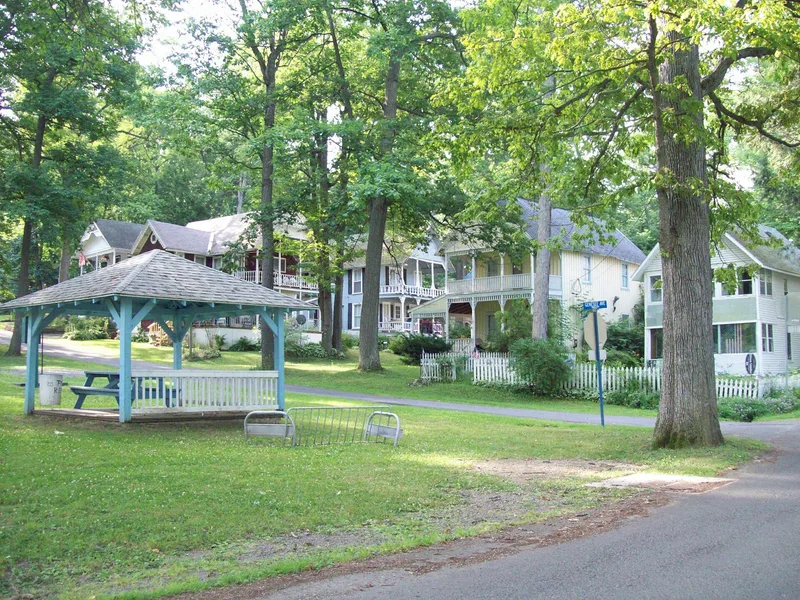
Silver Lake Institute is a small summer community of about fifty acres on the eastern shore of Silver Lake in Wyoming County, New York. Several hundred small buildings, mostly cottages, sit on small lots along narrow lanes that converge on Burt Park, a grassy, tree-lined open space that was the original grove where assemblies were held. The historic district includes the park and 72 other properties, with 76 contributing components and one non-contributing building. Most were built between 1873 and 1930 in wood. The earliest cottages, from 1873 to 1885, are narrow gable-front frame buildings with porches and Gothic Revival details. A building boom in the late 1880s and 1890s brought Queen Anne and Eastlake ornament, and later cottages show Colonial Revival and Bungalow influence. Two institutional buildings, Stoody Memorial Hall and the Hoag Art Gallery, date from 1892 and 1895. The district was drawn to exclude heavily altered areas and retains its historic character as a secluded lakeside retreat.
Machine-generated summary. This summary was generated by a language model from the official nomination document and has not been reviewed line by line by an editor. It may contain errors. Check the source document before relying on any detail. Source: nomination document (PDF) · catalog entry. Generated October 2026 (model claude-sonnet-5-5, prompt v1.0-2026-10-29).
| Styles | Vernacular cottages with Gothic Revival, Queen Anne, Eastlake, Stick, Colonial Revival and Bungalow influences |
|---|---|
| Areas of significance | Architecture, Religion |
| Acreage | 13 |
| Boundary source | NPS cultural-resource GIS polygon |
| Full listing page | Silver Lake Institute Historic District (property record) |
What listing means for this property
This is a historic district. Buildings within its boundary are either contributing (they add to the district's significance) or non-contributing. Owners of contributing income-producing buildings can claim the 20% federal rehabilitation tax credit; homeowners should look at state credits. National Register districts impose no design review by themselves; a local historic district ordinance, if one exists, does (the difference explained).
General information, not legal or tax advice. Rules change; confirm with your State Historic Preservation Office or a qualified adviser.