Second Street Historic District

The National Park Service has not published a boundary polygon for this district; the map shows the listed properties inside it and the district's reference point.
Why it's listed
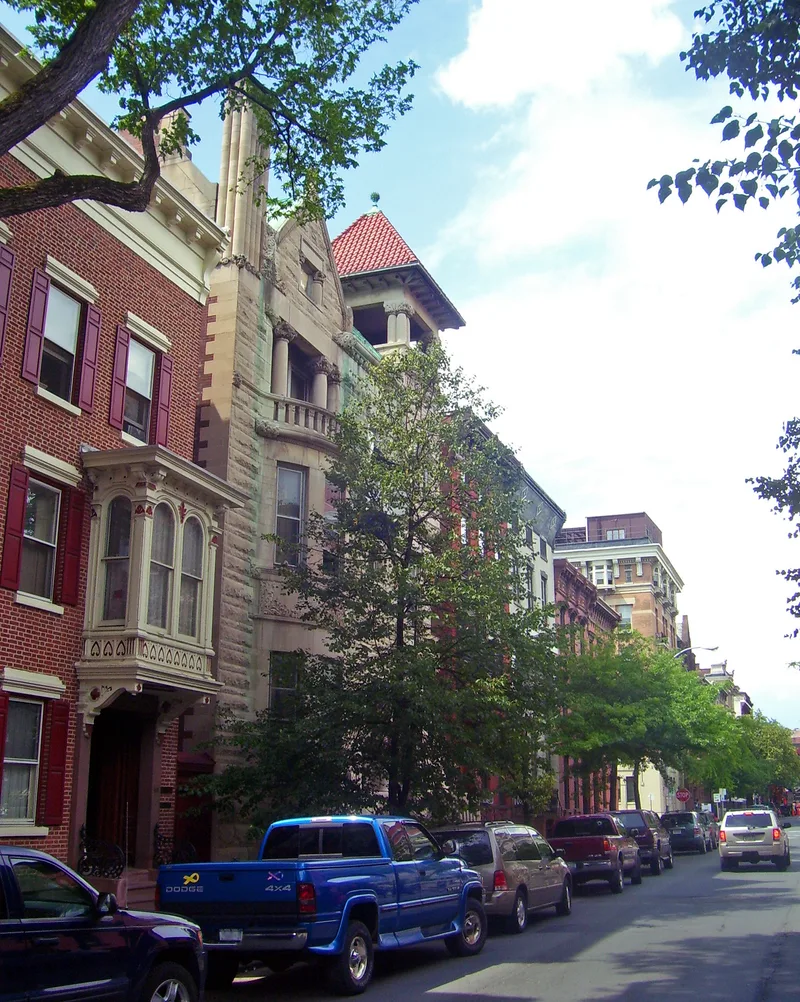
Second Street in Troy, New York, is one of the city's oldest major thoroughfares, and a six-block stretch of it forms a densely built historic district between Monument Square and the Washington Park Historic District. Most of its roughly 88 historic structures are two- or three-story brick and brownstone townhouses, built as homes for prominent Troy families and later adapted to offices and apartments. Larger stone buildings punctuate the street, including the Troy Savings Bank with its Music Hall, designed by George B. Post and completed in 1875, the Pioneer Savings Bank, the Rensselaer County Courthouse, and the Caldwell Apartments. Marcus F. Cummings and his son Frederick designed several buildings, including Russell Sage College halls and the former Y.W.C.A. Seminary Park recalls the Troy Female Seminary founded by Emma Willard. The district was listed for its well-preserved streetscape, architectural quality, and ties to the city's educational, governmental, commercial and cultural life.
Machine-generated summary. This summary was generated by a language model from the official nomination document and has not been reviewed line by line by an editor. It may contain errors. Check the source document before relying on any detail. Source: nomination document (PDF) · catalog entry. Generated October 2026 (model claude-sonnet-5-5, prompt v1.0-2026-10-29).
| Areas of significance | Landscape Architecture, Commerce, Education, Politics/Government, Architecture, Performing Arts |
|---|---|
| Acreage | 20 |
| Boundary source | not published |
| Full listing page | Second Street Historic District (property record) |
What listing means for this property
This is a historic district. Buildings within its boundary are either contributing (they add to the district's significance) or non-contributing. Owners of contributing income-producing buildings can claim the 20% federal rehabilitation tax credit; homeowners should look at state credits. National Register districts impose no design review by themselves; a local historic district ordinance, if one exists, does (the difference explained).
General information, not legal or tax advice. Rules change; confirm with your State Historic Preservation Office or a qualified adviser.