Public Square Historic District

Why it's listed
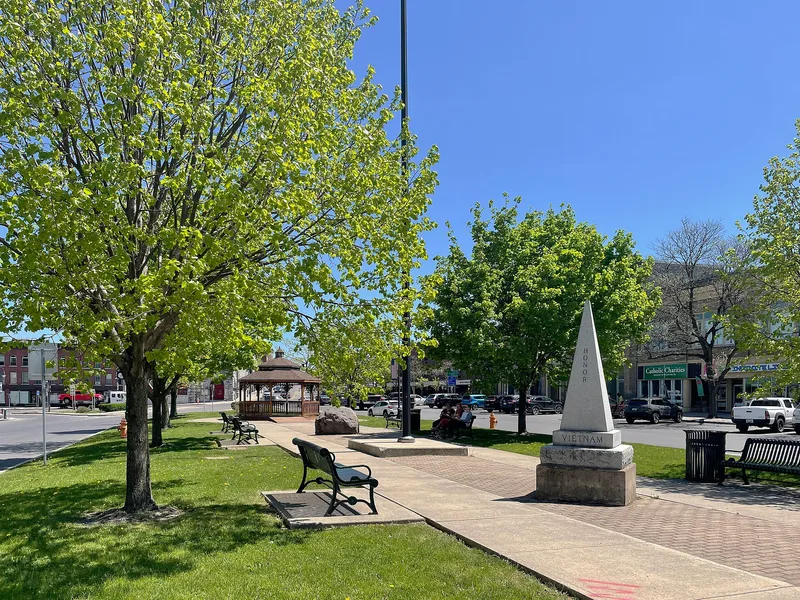
Public Square Historic District covers 66 properties in downtown Watertown, New York, organized around a village green laid out in 1805 and landscaped in 1855. Sixty-four buildings, a monument and the green itself make up the district, and 63 of the components contribute to its character. Most buildings are three- to four-story attached brick rows, in styles from Italianate and Romanesque Revival to Neoclassical, Commercial and Art Deco. Fires in 1848 and 1849 destroyed most of the earlier wooden downtown, and prosperity from steam engine manufacturing, textiles and paper making paid for a rebuilding in masonry from about 1850 to the early 1870s. Notable elements include the Paddock Arcade, a cast-iron fountain from 1869, the Soldiers' and Sailors' Monument of 1890, and the Marble Block of about 1873. Surrounding areas have been altered by modern construction and urban renewal, so the district preserves the only intact historic commercial core in the city.
Machine-generated summary. This summary was generated by a language model from the official nomination document and has not been reviewed line by line by an editor. It may contain errors. Check the source document before relying on any detail. Source: nomination document (PDF) · catalog entry. Generated October 2026 (model claude-sonnet-5-5, prompt v1.0-2026-10-29).
| Styles | Italianate, Romanesque Revival, Neoclassical, Commercial and Art Deco, with vernacular and eclectic interpretations |
|---|---|
| Areas of significance | Commerce, Architecture |
| Acreage | 16 |
| Boundary source | NPS cultural-resource GIS polygon |
| Full listing page | Public Square Historic District (property record) |
What listing means for this property
This is a historic district. Buildings within its boundary are either contributing (they add to the district's significance) or non-contributing. Owners of contributing income-producing buildings can claim the 20% federal rehabilitation tax credit; homeowners should look at state credits. National Register districts impose no design review by themselves; a local historic district ordinance, if one exists, does (the difference explained).
General information, not legal or tax advice. Rules change; confirm with your State Historic Preservation Office or a qualified adviser.