Pierce Arrow Factory Complex

Why it's listed
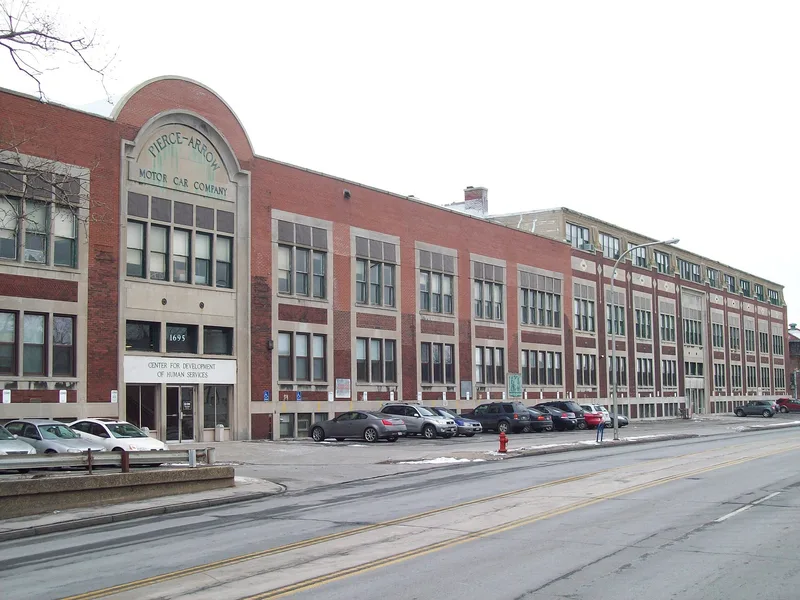
Covering 34 acres in Buffalo, this former automobile plant was built in 1906-7 for the George N. Pierce Company, maker of Pierce-Arrow cars. It includes about fourteen major buildings, among them a long Administration Building on Elmwood Avenue, one-story Manufacturing and Assembly buildings with sawtooth roofs, and a 1,150-foot Body Building along Great Arrow Avenue. Reinforced concrete was used for the structure. Albert Kahn's firm, Lockwood, Greene and Company, and the Trussed Concrete Steel Company took part in the design. The plant is noted because it combined clear interior spans, wide window walls, roof lighting and horizontal circulation from process to process, a pattern later copied in many factories. An arrow motif remains in the brickwork and stair railings of the Administration Building. The company went bankrupt in 1938, and the complex is now used for commercial enterprises, union meeting rooms, truck garages and warehouses. Alterations have covered many windows and roofs, yet the structures remain largely intact.
Machine-generated summary. This summary was generated by a language model from the official nomination document and has not been reviewed line by line by an editor. It may contain errors. Check the source document before relying on any detail. Source: nomination document (PDF) · catalog entry. Generated October 2026 (model claude-sonnet-5-5, prompt v1.0-2026-10-29).
| Period of significance | 1906-1910 |
|---|---|
| Areas of significance | Industry, Engineering, Architecture, Invention |
| Acreage | 34 |
| Boundary source | NPS cultural-resource GIS polygon |
| Full listing page | Pierce Arrow Factory Complex (property record) |
What listing means for this property
This is a historic district. Buildings within its boundary are either contributing (they add to the district's significance) or non-contributing. Owners of contributing income-producing buildings can claim the 20% federal rehabilitation tax credit; homeowners should look at state credits. National Register districts impose no design review by themselves; a local historic district ordinance, if one exists, does (the difference explained).
General information, not legal or tax advice. Rules change; confirm with your State Historic Preservation Office or a qualified adviser.