Petrified Sea Gardens

The National Park Service has not published a boundary polygon for this district; the map shows the listed properties inside it and the district's reference point.
Why it's listed
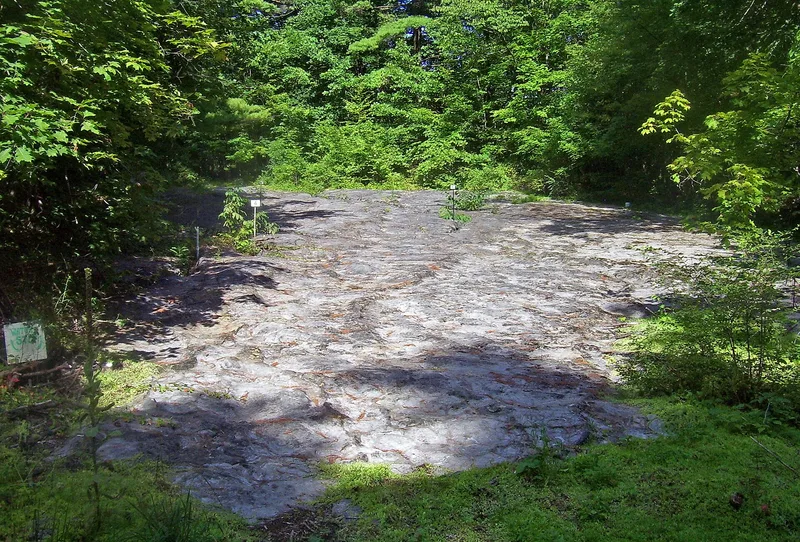
Petrified Sea Gardens is a 25-acre wooded park west of Saratoga Springs, New York, where outcrops of Hoyt Limestone display stromatolites formed about 515 million years ago in a shallow Cambrian sea. These layered, cabbage-like structures were built by cyanobacteria, and glaciers later planed their tops to reveal the concentric layering. The fossils were first noted in 1825 by John Steele, and in 1883 James Hall named them Cryptozoon, the first stromatolites scientifically described in North America. Robert Ritchie, a stone mason and amateur geologist, uncovered the outcrop in 1922 and opened the park in 1924. In 1937 Winifred Goldring, New York's first woman State Paleontologist, published the most exhaustive study of the site and identified the organisms responsible. Living stromatolites studied in Australia in 1961 confirmed her interpretations. The site continues to serve school groups, students and professionals, and a non-profit group now operates it.
Machine-generated summary. This summary was generated by a language model from the official nomination document and has not been reviewed line by line by an editor. It may contain errors. Check the source document before relying on any detail. Source: nomination document (PDF) · catalog entry. Generated October 2026 (model claude-sonnet-5-5, prompt v1.0-2026-10-29).
| Period of significance | 1825-1948 |
|---|---|
| Areas of significance | Science |
| Acreage | 1.5 |
| Boundary source | not published |
| Full listing page | Petrified Sea Gardens (property record) |
What listing means for this property
This is a historic district. Buildings within its boundary are either contributing (they add to the district's significance) or non-contributing. Owners of contributing income-producing buildings can claim the 20% federal rehabilitation tax credit; homeowners should look at state credits. National Register districts impose no design review by themselves; a local historic district ordinance, if one exists, does (the difference explained).
General information, not legal or tax advice. Rules change; confirm with your State Historic Preservation Office or a qualified adviser.