Park Square Historic District

The National Park Service has not published a boundary polygon for this district; the map shows the listed properties inside it and the district's reference point.
Why it's listed
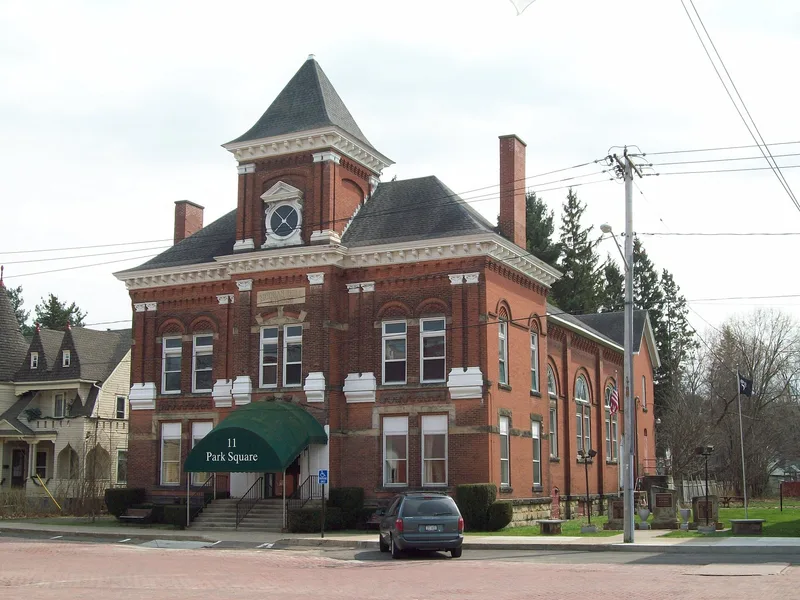
Park Square is the historic center of Franklinville, a village in Cattaraugus County, New York. The district centers on an elliptical green laid out in 1876 after land at an irregular crossroads was donated to the village. Brick-paved streets and 21 contributing buildings surround it. Most are two-story Italianate commercial blocks from the 1870s to 1890s, with cast-iron storefront columns, corbelled brickwork and bracketed cornices. Other landmarks include the 1828 Federal style inn at 4 North Park Square, the 1885 Queen Anne style Morgan Hall, the 1905 fire department building, the 1914 Blount Library and the 1924 Neoclassical bank. Four buildings do not contribute because of heavy alteration or recent construction. The district reflects the village's move from a frontier crossroads to a farm market town, helped by the arrival of the railroad in 1872. It retains its historic scale, layout and architectural character, making it an unusual example of community development around a public square in Western New York.
Machine-generated summary. This summary was generated by a language model from the official nomination document and has not been reviewed line by line by an editor. It may contain errors. Check the source document before relying on any detail. Source: nomination document (PDF) · catalog entry. Generated October 2026 (model claude-sonnet-5-5, prompt v1.0-2026-10-29).
| Period of significance | 1828-1924 |
|---|---|
| Styles | Federal, Italianate, Queen Anne and Neoclassical |
| Areas of significance | Architecture |
| Acreage | 4 |
| Boundary source | not published |
| Full listing page | Park Square Historic District (property record) |
What listing means for this property
This is a historic district. Buildings within its boundary are either contributing (they add to the district's significance) or non-contributing. Owners of contributing income-producing buildings can claim the 20% federal rehabilitation tax credit; homeowners should look at state credits. National Register districts impose no design review by themselves; a local historic district ordinance, if one exists, does (the difference explained).
General information, not legal or tax advice. Rules change; confirm with your State Historic Preservation Office or a qualified adviser.