Palmer-Lewis Estate

Why it's listed
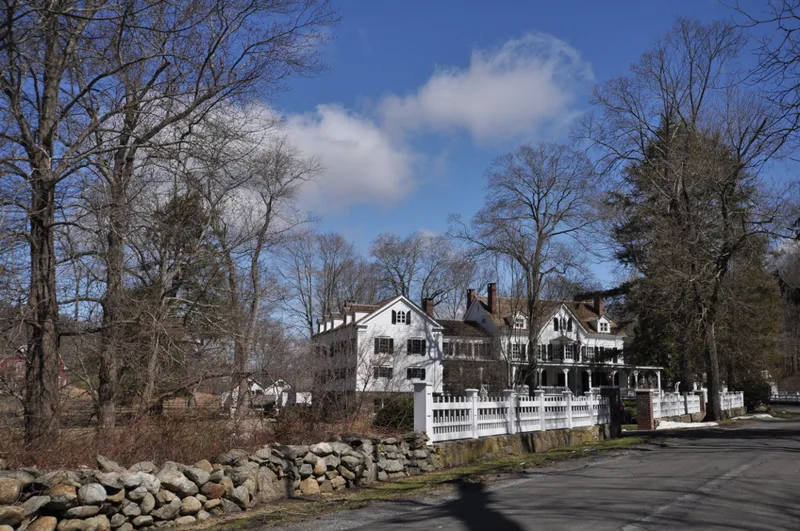
Set on both sides of Black Brook Road in semi-rural Bedford, this 31-acre estate combines a country house with the core of a working family farm. The main house dates to about 1779 and retains heavy timber framing, fieldstone foundations and wide-board floors from that period. About 1860, Francis Palmer, who had risen from stage driver to omnibus owner, then president of the National Broadway Bank and New York City chamberlain, enlarged and redesigned it as an Italianate summer residence with a bracketed porch on three sides. Around the house are fifteen mostly frame outbuildings, including a carriage house, residences, sheds, well houses and a barn complex arranged as a quadrangle. Stone walls enclose small fields that show how intensively the land was farmed, along with remains of an orchard and a vegetable garden. Much of the original acreage has been subdivided, so this core is the last evidence of the Palmer and Lewis families' long presence in Bedford.
Machine-generated summary. This summary was generated by a language model from the official nomination document and has not been reviewed line by line by an editor. It may contain errors. Check the source document before relying on any detail. Source: nomination document (PDF) · catalog entry. Generated October 2026 (model claude-sonnet-5-5, prompt v1.0-2026-10-29).
| Styles | Mid-nineteenth-century Italianate (main house), with Greek Revival elements and early twentieth-century Colonial Revival alterations |
|---|---|
| Areas of significance | Social History, Architecture, Agriculture |
| Acreage | 31 |
| Boundary source | NPS cultural-resource GIS polygon |
| Full listing page | Palmer-Lewis Estate (property record) |
What listing means for this property
This is a historic district. Buildings within its boundary are either contributing (they add to the district's significance) or non-contributing. Owners of contributing income-producing buildings can claim the 20% federal rehabilitation tax credit; homeowners should look at state credits. National Register districts impose no design review by themselves; a local historic district ordinance, if one exists, does (the difference explained).
General information, not legal or tax advice. Rules change; confirm with your State Historic Preservation Office or a qualified adviser.