Orleans County Courthouse Historic District

Why it's listed
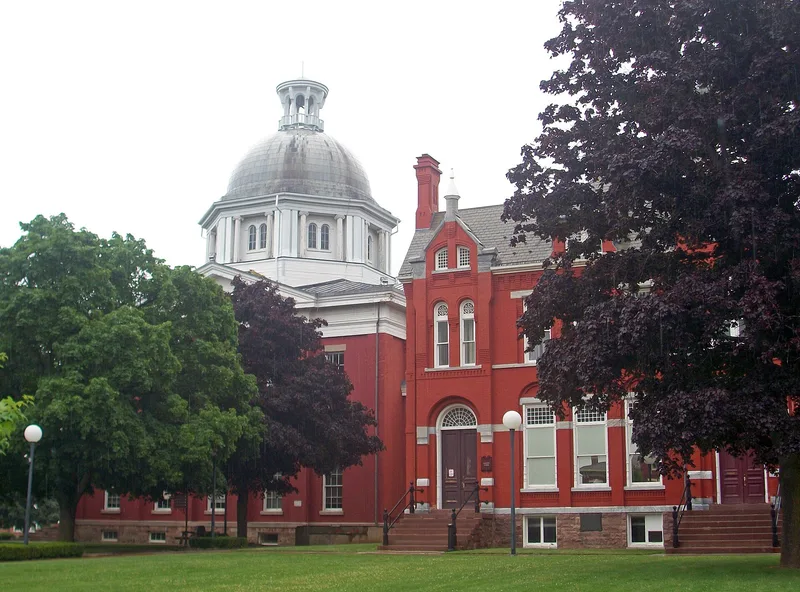
Courthouse Square in Albion, New York, anchors a district of 33 contributing buildings, most built between the 1830s and 1910. The square was given to Orleans County by Nehemiah Ingersoll and holds the 1858-59 courthouse designed by W.B.M. Barlow and the 1888 Surrogate's Building. Around it stand seven churches, eighteen houses and several public buildings, ranging from Federal and Greek Revival to Queen Anne and Colonial Revival. The Presbyterian Church, with a 175-foot spire, is the tallest structure in the county. Many buildings use Medina sandstone, quarried near Albion and important to the regional economy, including S.S. Beman's Pullman Memorial Universalist Church of 1894. The district reflects Albion's position as county seat, its Erie Canal and agricultural prosperity, and local religious history, including the first Free Methodist church. The 1937 post office and 1970 jail are noted as intrusions. Buildings are largely little altered, and the area still serves as the center of local life.
Machine-generated summary. This summary was generated by a language model from the official nomination document and has not been reviewed line by line by an editor. It may contain errors. Check the source document before relying on any detail. Source: nomination document (PDF) · catalog entry. Generated October 2026 (model claude-sonnet-5-5, prompt v1.0-2026-10-29).
| Period of significance | 1830s to 1910 (form checks 1800-1899 and 1900-1910) |
|---|---|
| Styles | Greek Revival, Gothic Revival, Italianate, Romanesque, Queen Anne, Second Empire, Eastlake, Colonial Revival and Federal |
| Areas of significance | Politics/Government, Architecture, Religion |
| Acreage | 15 |
| Boundary source | NPS cultural-resource GIS polygon |
| Full listing page | Orleans County Courthouse Historic District (property record) |
What listing means for this property
This is a historic district. Buildings within its boundary are either contributing (they add to the district's significance) or non-contributing. Owners of contributing income-producing buildings can claim the 20% federal rehabilitation tax credit; homeowners should look at state credits. National Register districts impose no design review by themselves; a local historic district ordinance, if one exists, does (the difference explained).
General information, not legal or tax advice. Rules change; confirm with your State Historic Preservation Office or a qualified adviser.