North Main Street Historic District

Why it's listed
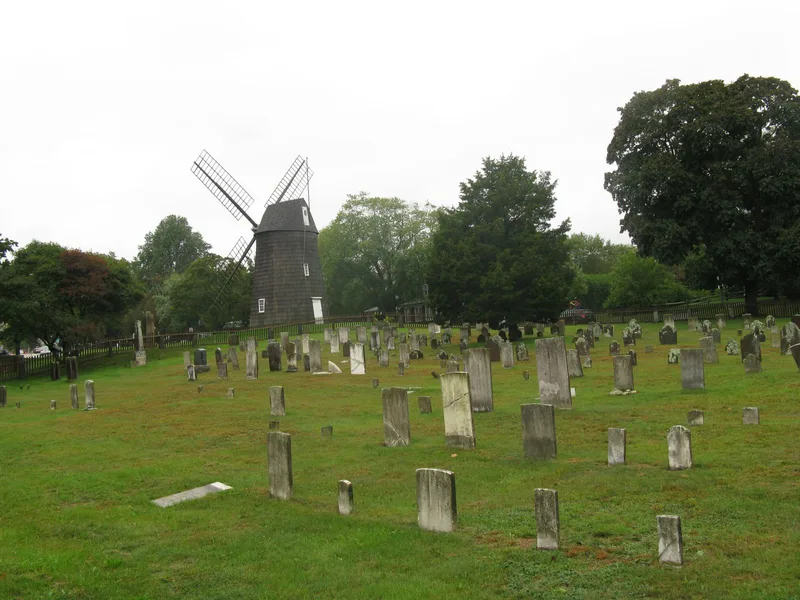
Clustered around the Y-shaped junction of North Main Street and Pantigo Road at the northern edge of East Hampton village, this district contains 20 contributing buildings, two structures and one site, all frame-built and dating from 1770 to 1901. Its center is open space holding the North End Cemetery, established in 1770 and noted for finely carved headstones, and the Hook Windmill, a sixty-foot smock mill built in 1806 by millwright Nathaniel Dominy V that milled grain until 1910. Around them stand houses tracing nineteenth-century taste, from the Federal-style Abraham Huntting House of about 1835 to the Greek Revival William Bennett House of 1849, Italianate and Queen Anne examples, and the 1895 Shingle-style Bell House. The 1901 United Methodist Church, with its tower and spire, anchors one end. Similar scale, materials, shade trees and picket fences unify the group, and its historic layout around a former common distinguishes it from other neighborhoods in the village.
Machine-generated summary. This summary was generated by a language model from the official nomination document and has not been reviewed line by line by an editor. It may contain errors. Check the source document before relying on any detail. Source: nomination document (PDF) · catalog entry. Generated October 2026 (model claude-sonnet-5-5, prompt v1.0-2026-10-29).
| Period of significance | 1770-c. 1910 |
|---|---|
| Styles | Federal, Greek Revival, Italianate, Queen Anne, Shingle style, Gothic details |
| Areas of significance | Architecture |
| Acreage | 15 |
| Boundary source | NPS cultural-resource GIS polygon |
| Full listing page | North Main Street Historic District (property record) |
What listing means for this property
This is a historic district. Buildings within its boundary are either contributing (they add to the district's significance) or non-contributing. Owners of contributing income-producing buildings can claim the 20% federal rehabilitation tax credit; homeowners should look at state credits. National Register districts impose no design review by themselves; a local historic district ordinance, if one exists, does (the difference explained).
General information, not legal or tax advice. Rules change; confirm with your State Historic Preservation Office or a qualified adviser.