North Main-Bank Streets Historic District

Why it's listed
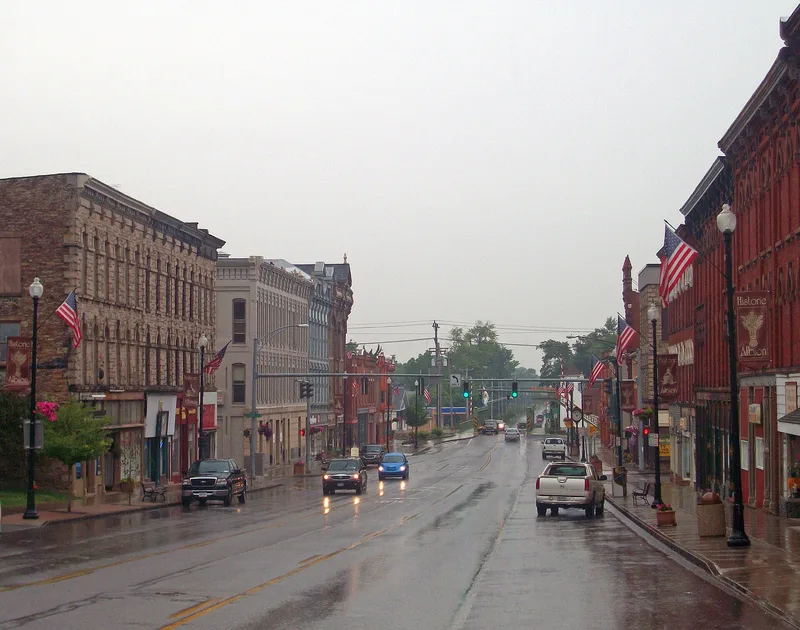
Albion's historic commercial core, along North Main and Bank Streets and a stretch of the Barge Canal, forms a district of 46 contributing buildings and structures built between about 1827 and about 1930. Most are three-story attached rows of brick or roughly hewn Medina sandstone, with Italianate and late Victorian eclectic styling. Landmarks include the Swan Block, the Pratt Opera House, the Granite Block of 1866, the Empire Block, the Royce Block and the 1873 Village Hall and firehouse, along with early Greek Revival buildings such as the Burrows Block. Two vernacular sandstone carriage buildings represent local industry. The district matters because Albion grew with the Erie Canal, which opened through the village in 1824, the same year it became the Orleans County seat. It served as a distribution point for fruit, wheat and Medina sandstone. Although many storefronts have been altered, the upper floors keep a high degree of integrity, making this one of the more intact canal-town business districts in Western New York.
Machine-generated summary. This summary was generated by a language model from the official nomination document and has not been reviewed line by line by an editor. It may contain errors. Check the source document before relying on any detail. Source: nomination document (PDF) · catalog entry. Generated October 2026 (model claude-sonnet-5-5, prompt v1.0-2026-10-29).
| Period of significance | ca. 1827 - ca. 1930 |
|---|---|
| Styles | Mid-19th Century Greek Revival; Late Victorian Italianate; 20th Century Classical Revival |
| Areas of significance | Architecture, Industry, Engineering, Commerce, Politics/Government, Transportation |
| Acreage | 18 |
| Boundary source | NPS cultural-resource GIS polygon |
| Full listing page | North Main-Bank Streets Historic District (property record) |
What listing means for this property
This is a historic district. Buildings within its boundary are either contributing (they add to the district's significance) or non-contributing. Owners of contributing income-producing buildings can claim the 20% federal rehabilitation tax credit; homeowners should look at state credits. National Register districts impose no design review by themselves; a local historic district ordinance, if one exists, does (the difference explained).
General information, not legal or tax advice. Rules change; confirm with your State Historic Preservation Office or a qualified adviser.