Murray Street Historic District

The National Park Service has not published a boundary polygon for this district; the map shows the listed properties inside it and the district's reference point.
Why it's listed
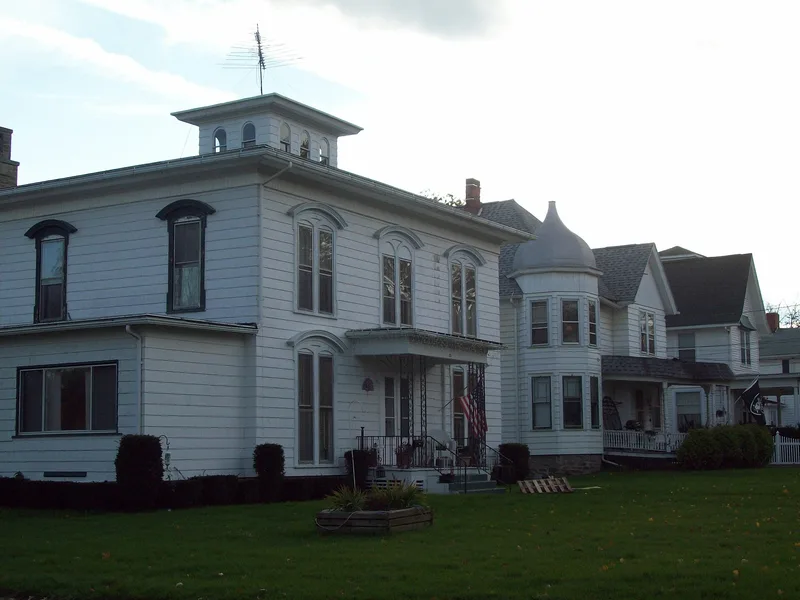
Murray Street in Mount Morris, Livingston County, holds a compact group of sixteen middle-class houses between Stanley and Eagle Streets, one block west of Main Street. Built between about 1820 and 1920, the frame and brick dwellings are similar in scale, spacing and setback, and are tied together by mature trees, continuous sidewalks and early twentieth-century street lamps. Styles run from Greek Revival and Italianate to Second Empire, Queen Anne and Foursquare, mostly in modest vernacular forms. Six contributing carriage houses and garages remain, along with a stone carriage step and a cast-iron hitching post. The house at 47 Murray Street, from 1872, was designed by Anna Rockfellow, an MIT graduate who studied in France; its mansard roof reflects French influence. Most of the surrounding historic neighborhood has lost integrity, so this block is one of only two small concentrations of intact dwellings. It was listed for its architecture and for illustrating the village's growth through the nineteenth and early twentieth centuries.
Machine-generated summary. This summary was generated by a language model from the official nomination document and has not been reviewed line by line by an editor. It may contain errors. Check the source document before relying on any detail. Source: nomination document (PDF) · catalog entry. Generated October 2026 (model claude-sonnet-5-5, prompt v1.0-2026-10-29).
| Period of significance | ca. 1820 - ca. 1920 |
|---|---|
| Styles | Greek Revival, Italianate, Second Empire, Queen Anne, Foursquare |
| Areas of significance | Architecture |
| Acreage | 4 |
| Boundary source | not published |
| Full listing page | Murray Street Historic District (property record) |
What listing means for this property
This is a historic district. Buildings within its boundary are either contributing (they add to the district's significance) or non-contributing. Owners of contributing income-producing buildings can claim the 20% federal rehabilitation tax credit; homeowners should look at state credits. National Register districts impose no design review by themselves; a local historic district ordinance, if one exists, does (the difference explained).
General information, not legal or tax advice. Rules change; confirm with your State Historic Preservation Office or a qualified adviser.