Mount Hope-Highland Historic District (Boundary Increase)

The National Park Service has not published a boundary polygon for this district; the map shows the listed properties inside it and the district's reference point.
Why it's listed
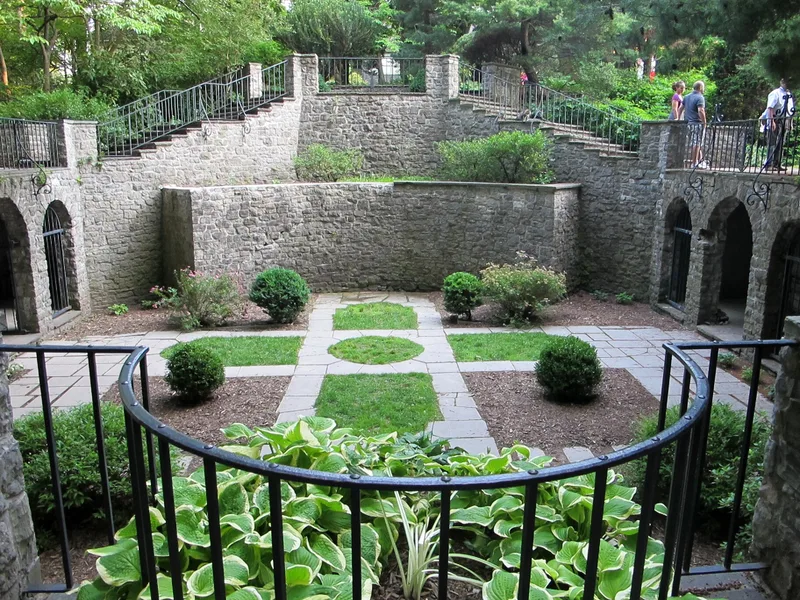
Mt. Hope-Highland is a residential and parkland district of roughly 200 acres on the east bank of the Genesee River in Rochester. It takes in Mt. Hope Avenue, the older part of Mt. Hope Cemetery, Highland Park, Menlo Place, Castle Park and several small side streets. Much of the land once belonged to the Ellwanger and Barry nursery, which became one of the largest in the world. The two nurserymen shaped the area by commissioning leading architects, including A.J. Davis, who designed their stone nursery office in 1854-55. Nearby are Warner Castle, a Scottish-style castle of 1854, the Patrick Barry House of 1857, Gothic cottages for nursery employees, and shingle-style houses linked to Claude Bragdon. The cemetery adds a gatehouse, a chapel of 1863 and winding stone-paved roads. In 1887 the nursery owners gave twenty acres to the city as the start of Highland Park. The district was recognized for its architecture, landscape, planning and social history.
Machine-generated summary. This summary was generated by a language model from the official nomination document and has not been reviewed line by line by an editor. It may contain errors. Check the source document before relying on any detail. Source: nomination document (PDF) · catalog entry. Generated October 2026 (model claude-sonnet-5-5, prompt v1.0-2026-10-29).
| Styles | Gothic Revival, Shingle style and other 19th and early 20th century residential styles |
|---|---|
| Areas of significance | Community Planning and Development, Landscape Architecture, Architecture |
| Acreage | 109.12 |
| Boundary source | not published |
| Full listing page | Mount Hope-Highland Historic District (Boundary Increase) (property record) |
What listing means for this property
This is a historic district. Buildings within its boundary are either contributing (they add to the district's significance) or non-contributing. Owners of contributing income-producing buildings can claim the 20% federal rehabilitation tax credit; homeowners should look at state credits. National Register districts impose no design review by themselves; a local historic district ordinance, if one exists, does (the difference explained).
General information, not legal or tax advice. Rules change; confirm with your State Historic Preservation Office or a qualified adviser.